Goa Gajah From Nusa Dua: The Elephant Cave, Honestly Planned
By Villa Soleil · Published August 2026 · 7 min read
Quick answer: Goa Gajah sits near Ubud, about 1.5–2 hours by car from Nusa Dua. It’s a small, deeply atmospheric site — allow 60–90 minutes on the ground — so it works best paired with Ubud rather than as a standalone trip. Our host at Villa Soleil can arrange a private driver and a sensible morning itinerary so you beat the heat and the tour buses.
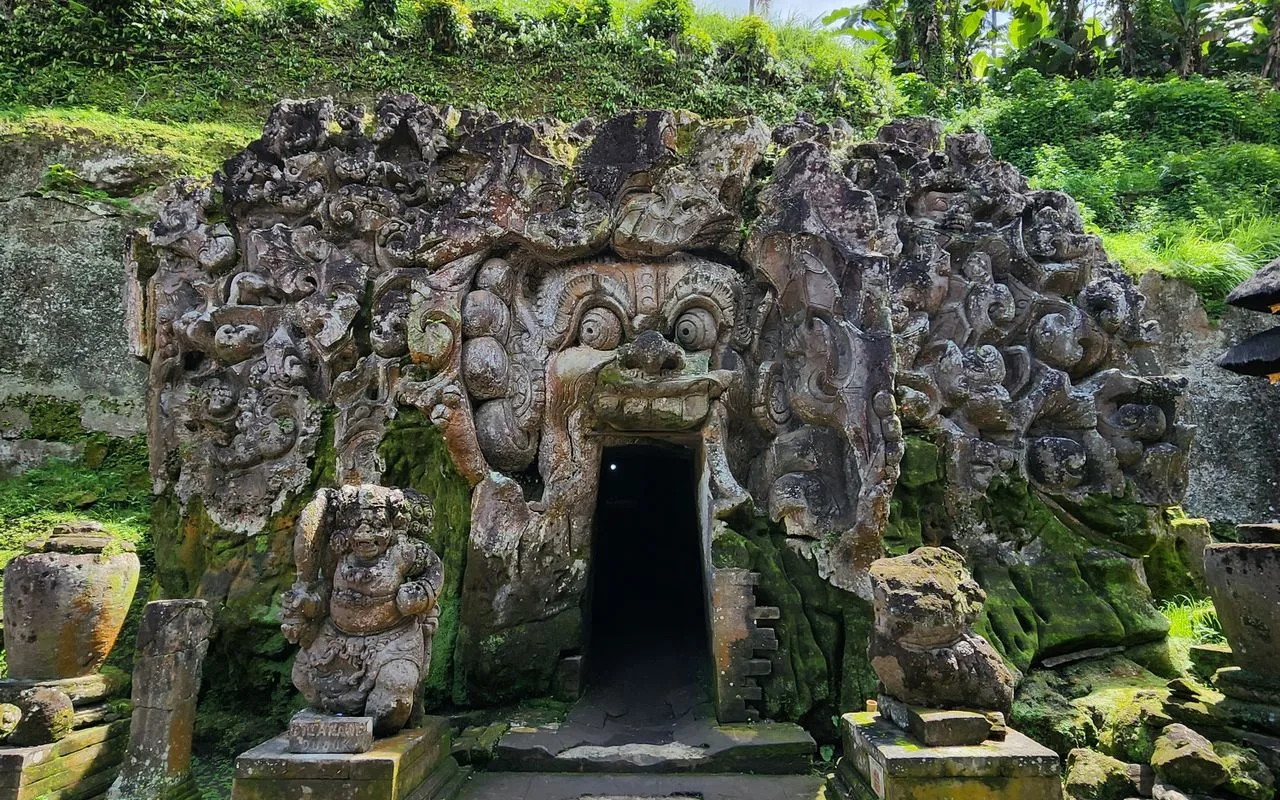
There are no elephants at Goa Gajah, and the cave you came to see is the size of a small chapel. What you get instead is a carved mouth shaped like a gaping demon’s face, a low T-shaped meditation chamber, and a set of stone bathing pools that stayed buried until 1954. From Villa Soleil in Nusa Dua it is a half-day commitment, and it rewards the traveller who slows down rather than the one ticking boxes. This guide tells you what to expect, how far it really is, and how to fold it into a day worth the drive.
What Goa Gajah Actually Is
Despite the name, there are no elephants here. “Goa Gajah” most likely refers to a nearby river once called Elephant River, or to a stone figure of the Hindu god Ganesha (who has an elephant head) found inside the cave. The site dates to roughly the 11th century and shows both Hindu and Buddhist influences, which is part of what makes it unusual — it sat at a meeting point of religious traditions.
You enter through that carved face, hewn straight into the rock. Inside, the T-shaped cave is dim, low, and short — you will not be spelunking. There is a lingga-yoni shrine and a small Ganesha statue. Outside, the rectangular bathing pools, with their stone water-spout figures, were excavated in 1954 and are the photogenic heart of the complex. Beyond them, a path leads down through banyan trees and a stream valley to scattered rock-cut relics — a quieter, greener walk most rushed visitors skip.
The Honest Distance From Nusa Dua
This is the part many guides gloss over. Goa Gajah is near Ubud, in Gianyar, on the far side of greater Denpasar from where you are sleeping. Expect 1.5 to 2 hours each way from Nusa Dua, traffic depending. That is a real commitment for a 60–90-minute site, and going there and straight back is, frankly, a poor use of a Bali day.
The smart move is to treat Goa Gajah as the opening act of an Ubud day. It sits on the southeastern approach to Ubud town, so you can stop here first, then continue to the centre. Our Ubud day trip guide lays out a full loop, and the broader Bali temple guide helps you decide which other temples are worth your limited north-bound hours.
| From Nusa Dua to… | Approx. drive | Pairs well with Goa Gajah? |
|---|---|---|
| Goa Gajah | 1.5–2 hr | — |
| Ubud centre & Monkey Forest | 1.5–2 hr | Yes — 10 min apart, ideal pairing |
| Tirta Empul (Tampaksiring) | 1.5–2 hr | Yes — same direction, add 40 min |
| Tegallalang rice terrace | 2–2.5 hr | Yes, but a long, full day |
| Campuhan Ridge walk | 1.5–2 hr | Yes — do the walk early, cave after |
When To Go (Timing Is Everything)
Goa Gajah is compact, so crowds are felt sharply. Tour coaches tend to roll in from mid-morning, and by late morning the bathing-pool area can be shoulder-to-shoulder. Because you are starting far away in Nusa Dua, aim to leave the villa by around 7:00–7:30 am to arrive close to opening. You will get cooler air, softer light for photos, and the cave largely to yourself.
The site is open daily, typically from the morning through late afternoon. In the wetter months the stone steps and lower jungle path get slick, so footwear matters — see our Bali rainy season notes if you are travelling between roughly November and March. For choosing your overall dates, the best time to visit Bali guide is a useful companion.
Tickets, Dress Code & Etiquette
Goa Gajah is an active spiritual site, not a museum, and modest dress is required. The entrance fee is modest — realistically around IDR 50,000 per adult, with reduced rates for children; fees are reviewed periodically, so check the posted rate on arrival. A sarong is mandatory to enter, and one is usually provided or loaned at the gate, but bringing your own is easier.
- Cover shoulders and knees. A sarong over shorts or a short dress is enough; a light scarf for shoulders helps.
- Mind the steps. The descent into the pool area and lower valley is uneven and can be slippery — sandals with grip beat flip-flops.
- Menstruating visitors are, by Balinese custom, asked not to enter certain temple inner areas. It is a quiet convention rather than something policed.
- Photograph respectfully. Do not climb on shrines or pose flippantly at the cave mouth or pools.
For the fuller picture on offerings, gates, and behaviour, our Bali cultural etiquette guide is worth a five-minute read before you go. One piece of architecture you will see across the island: the classic split gate is called a candi bentar, and you will spot variations of it at many sites near Ubud.
How To Get There From The Villa
You have three realistic options, and from a Nusa Dua base the first is almost always best.
- Private driver for the day (recommended). The most comfortable choice: a car and driver wait while you explore, then carry you on to Ubud and back. Budget roughly IDR 700,000–950,000 for a full south-to-Ubud day, fuel and parking included. Our host can arrange a trusted driver directly.
- Ride-hail apps. Workable for one leg, but return pickups from the Ubud area can be patchy and you lose the flexibility of stops. See our Bali transportation overview.
- Self-drive scooter. Only for confident riders — that is a long, busy highway run from the south, and not one we recommend for this distance. If you do ride locally, read the scooter rental guide first.
Whichever you choose, message the Villa Soleil team the night before and a driver can be at the door at sunrise with the route already planned.
Building A Day Around Goa Gajah
Because the cave only needs an hour or so, the real question is what to wrap around it. Two itineraries work especially well from the south, both starting early.
The culture loop: Goa Gajah first, then 40 minutes north to Tirta Empul for the holy springs, then back into Ubud for lunch and the Monkey Forest. This keeps you in one corridor and avoids backtracking.
The scenery loop: Goa Gajah, then a relaxed Ubud lunch, then the Tegallalang rice terrace for late-afternoon light before the drive home. This one is a full, satisfying day — expect to be back at the villa after dark.
If you would rather not drive so far at all, the south has its own quieter cultural draws: GWK Cultural Park and the cliff-top temple at Uluwatu are both far closer to Nusa Dua and pair beautifully with a sunset.
Eating & Resting Nearby
Around Goa Gajah and on the road into Ubud you will find warungs and a few open-air cafes overlooking rice fields — ideal for a mid-morning coffee or an early lunch before the crowds. This is good country for a slow nasi campur or, if you plan ahead, a clay-pot ayam betutu, the slow-cooked spiced chicken wrapped in areca-palm sheath and banana leaf. For the dishes worth seeking out, browse our Balinese food guide.
A private villa also frees you from restaurant hours after a long drive. Many guests prefer to return to the quiet of Villa Soleil and have our team arrange a private chef dinner by the pool rather than fight evening traffic for a meal out.
Is Goa Gajah Worth It From Nusa Dua?
It depends entirely on how you go. As a standalone two-hour-each-way pilgrimage to a one-hour site, no. As the contemplative first stop of a well-planned Ubud day, absolutely — it is ancient, atmospheric, and refreshingly free of theme-park gloss. It rewards an early start, a sarong, and a willingness to walk down past the pools to the quiet relics most people never reach.
The difference between a sweaty disappointment and a memorable morning usually comes down to logistics: leaving early, having a driver who knows the route, and chaining the right stops together. Message the Villa Soleil team on WhatsApp at +62 877 7000 1535 and we will map out an Ubud day; booking direct is cheaper than the platforms.
Related reading
- Ubud Day Trip From Nusa Dua
- Bali Temple Guide: Where To Go & Etiquette
- Tegallalang Rice Terrace
- Bali Cultural Etiquette for Visitors
Written by the team at Villa Soleil. Message us to plan your stay in Nusa Dua.