Bali Cultural Etiquette: Temple, Beach & Daily Manners
By Villa Soleil · Published May 2026 · 8 min read
- Why etiquette matters more in Bali than most places
- Temple etiquette
- Daily ritual: canang sari (those flower offerings on the sidewalk)
- Body language taboos
- Public behavior and dress
- Tipping in Bali
- Special occasions: Nyepi and Galungan
- Photography etiquette
- At the villa or hotel
- The villa perspective
Why etiquette matters more in Bali than most places
Bali is a Hindu island in a Muslim-majority country, with religious life woven into every street, every business, every morning. Locals see thousands of tourists daily — but the way you behave still changes how warmly you're received, and how much access you get to the parts of Bali that aren't on Instagram. A few hours learning the basics pays back in months of better experiences.
Temple etiquette
Every Balinese temple (pura) has the same baseline expectations:
| Rule | Detail | Why |
|---|---|---|
| Cover shoulders & legs | Sarong (waist down) + sash (waist) required | Both genders. Rented at entrance for IDR 10-30k or included. |
| Menstruating women don't enter | Stated openly, no offense if you opt out | Traditional cleanliness rule. Voluntary self-report. |
| Don't climb on shrines | Includes for photos | Sacred objects, not selfie backdrops. |
| Don't point feet at shrines | When seated, fold legs under | Feet are considered the lowest, least pure part of body. |
| Stand below or beside priest | Never higher than the priest's head | Hierarchy of sacredness extends to spatial position. |
| Quiet voice | Especially during prayer | Sound carries, ceremonies are deeply concentrated. |
| Don't walk in front of those praying | Walk behind or around | Like crossing in front of someone reading, multiplied. |
Major temples (Uluwatu, Tanah Lot, Besakih) all rent sarongs and explain rules at the gate. Small village temples expect you to know the basics.
Daily ritual: canang sari (those flower offerings on the sidewalk)
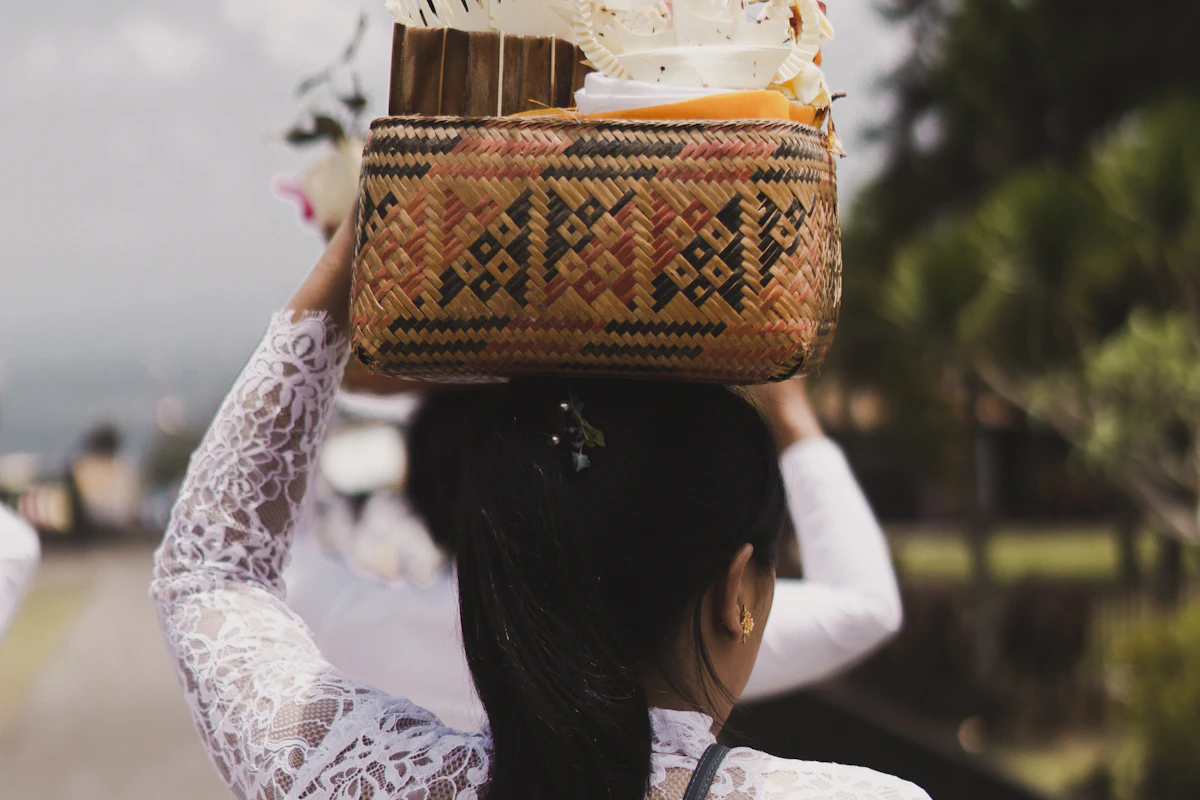
If you walk anywhere in Bali, you'll see small woven palm-leaf baskets filled with flowers, rice, and a stick of incense. These are canang sari — daily offerings placed at shop entrances, sidewalks, dashboards, shrines. Three things to know:
- Never step on them. They represent direct gifts to spirits. Walking around them is respectful.
- Don't kick them. Even accidentally. If your shoe nudges one, set it back upright if obvious.
- Don't take the flowers. They look pretty. They're not for you.
If you accidentally step on one, no scene will happen. But locals notice the visitors who don't — and that's the small thing that earns warmer treatment everywhere else.
Body language taboos
- Don't touch heads — Balinese consider the head sacred. Don't ruffle a child's hair, even friendly. Pat shoulders instead.
- Don't point with your finger — point with your thumb (closed fist, thumb out) or open palm. Finger-pointing is rude.
- Don't hand things with your left hand — left hand is traditionally for personal hygiene. Use right hand or both hands.
- Don't show soles of feet — when sitting cross-legged, hide your soles. Feet pointed at someone is disrespectful.
- Don't lose temper publicly — Balinese culture values composure (tenget). Raising voice at staff makes everyone uncomfortable and won't get what you want faster.
Public behavior and dress
Bali is more relaxed than Java or Sumatra about Western dress — bikinis at the beach, swimwear at pool clubs are fine. But there's a clear scale:
| Where | Acceptable | Avoid |
|---|---|---|
| Beach / pool | Swimwear | Nudity (no nude beaches in Bali) |
| Beach club | Swimwear + cover-up | Walking topless to dining area |
| Restaurant | Casual smart, shorts OK | Bare feet, wet swimwear |
| Town / market | Shorts + t-shirt | Bikini top, short shorts in traditional areas |
| Temple | Sarong + covered shoulders | Anything tighter than knees |
| Local village | Modest casual | Walking with beer in hand |
Tipping in Bali
Tipping isn't mandatory but is genuinely appreciated:
- Restaurants: 5-10% if not on bill. Many restaurants add "service charge" automatically — check before tipping again.
- Private drivers/guides: IDR 50-100k per day. They remember.
- Villa staff: IDR 100-200k per night, collected at end and split among staff. We arrange this at Villa Soleil if you ask.
- Spa therapists: IDR 30-50k per treatment.
- Hotel housekeeping: IDR 20-30k per day if cleaning your room.
- Taxi drivers: Round up to nearest 10k. Don't tip more — they don't expect it.
Special occasions: Nyepi and Galungan
Two major Hindu observances affect what you can do:
- Nyepi (Balinese New Year, around March): 24-hour silence. No flights for 24 hours. No driving, no outdoor lights, no leaving accommodation. Most beaches and restaurants closed. Hotels and villas serve limited room-service. Plan to read, journal, sleep. Check the exact date in our timing guide.
- Galungan + Kuningan (every 210 days): Bali's largest celebration. Streets lined with bamboo penjor poles. Beautiful for visitors but expect closed shops and busy temples. No restrictions on tourists.
If your trip overlaps Nyepi specifically, treat it as a feature, not a bug. Many returning travelers come back specifically to experience the silence.
Photography etiquette
- Ask before photographing locals — a smile and gesture toward your camera. Most say yes warmly.
- Don't photograph people praying without explicit permission. This is more important than any other photo rule.
- Don't use drones over temples or ceremonies — restricted by local law and disrespectful to ritual.
- Selfie sticks at temples — some pura ban them. Check signs.
- Wedding/family ceremonies on the street — you can watch from distance respectfully but don't get close with camera.
At the villa or hotel
- Staff are not friends — be warm but professional. The line is finer in Bali than in resort cultures.
- Don't gift cash directly — collect tips at end of stay and give to manager to split.
- Quiet hours after 22:00 — sound carries between villas in most complexes.
- Don't bring outside alcohol to in-villa dining if a chef is preparing — they often have included wine.
- Inform staff before swimming after dark — pool safety, plus they may want to leave low lighting on.
"Etiquette in Bali isn't about getting things right. It's about getting along — and locals notice every small effort."
The villa perspective
We host hundreds of stays a year. The travelers who get the most out of Bali — best food recommendations, custom ceremonies witnessed, real friendships with staff — are the ones who treat etiquette as part of the trip, not an obstacle.
At Villa Soleil, our team includes Balinese and Indonesian staff. They'll happily explain anything if you ask. Most cultural confusion sorts itself out the first time you mention you're not sure what's appropriate. The willingness to ask matters more than knowing.
Tell us your dates and any cultural experiences you'd like included — temple visits with a local guide, traditional cooking class, blessing ceremony — we can arrange most things with a few days' notice. Message us on WhatsApp.
Related reading
- Things to Do in Nusa Dua — temples and cultural sites worth visiting
- Best Time to Visit Bali — check for Nyepi and Galungan dates
- Bali with Kids — extra etiquette for families
- Where to Stay in Bali — areas vary in cultural intensity
Written by the team at Villa Soleil. We live here. Message us on WhatsApp if any specific situation worries you.