Balinese Food: A What-to-Eat Primer for Your Bali Trip
By Villa Soleil · Published July 2026 · 8 min read
- Babi Guling — Balinese Suckling Pig
- Bebek & Ayam Betutu — The Slow-Cooked Centrepiece
- Sate Lilit — Bali’s Own Satay
- Lawar — The Dish That Scares People (Unnecessarily)
- Nasi Campur — The Whole Island on One Plate
- Jukut Ares & Other Comfort Dishes
- Jaja — Balinese Sweets & What to Drink
- At a Glance: The Seven Dishes
- A Few Notes on Eating Well & Safely
- What we arrange at Villa Soleil
The best babi guling in Bali sells out by early afternoon, which tells you most of what you need to know about the island’s food: it is cooked fresh, eaten at its peak, and built on a spice paste called base genep (a blend of shallot, garlic, galangal, turmeric, ginger, chilli, candlenut and more), grated coconut, lime leaf and plenty of chilli. Order nasi goreng on your first night and you eat well — but you eat Indonesian, not truly Balinese. Once you know the seven dishes that define the island’s own kitchen, every menu in Bali makes sense. This is our host’s practical guide to what to eat, what to expect, and where to find each one within easy reach of Villa Soleil in Nusa Dua.
We’ve written it for guests staying with us, anchored to our corner of the island (Benoa, Nusa Dua), with realistic prices in rupiah and honest notes on spice and texture. If you’d rather learn the dishes by cooking them, pair this with our Bali cooking class guide; if you want addresses near the villa, jump to our Nusa Dua restaurants roundup.
Babi Guling — Balinese Suckling Pig
If you eat pork, this is the dish that defines Balinese cuisine. A whole pig is stuffed with base genep, lemongrass and cassava leaf, then spit-roasted for hours until the skin shatters like glass and the meat falls apart. A proper portion (nasi babi guling) arrives over rice with crackling, a spoon of lawar, a piece of spiced sausage and a fiery sambal matah.
What to expect: rich, savoury, deeply seasoned, and crisp. It’s a lunch dish — the best places sell out by early afternoon and close, so go before 1pm. Expect to pay around IDR 45,000–75,000 for a plate at a famous warung. Note that babi guling is pork, so it’s off the menu for Muslim travellers; the rest of this list has plenty of alternatives. Because Bali is Hindu-majority, pork is cooked openly and proudly here in a way you won’t find elsewhere in Indonesia.
Bebek & Ayam Betutu — The Slow-Cooked Centrepiece
Betutu is the island’s ceremonial dish: a whole duck (bebek) or chicken (ayam) rubbed inside and out with spice paste, wrapped in an areca-palm sheath and banana leaf, and cooked low and slow — traditionally buried in embers — for six to eight hours. The result is meat so tender it pulls off the bone with a fork.
Ayam betutu is the easier introduction: milder, quicker to cook, widely available. Bebek betutu is richer and often needs ordering an hour ahead because it’s cooked to order. Both come with rice, plecing kangkung (water spinach with chilli), peanuts and sambal. Prices run roughly IDR 60,000–120,000 depending on whether you take a quarter or a whole bird. Tell the kitchen if you want it tidak pedas (not spicy) — classic betutu can be seriously hot.
Sate Lilit — Bali’s Own Satay
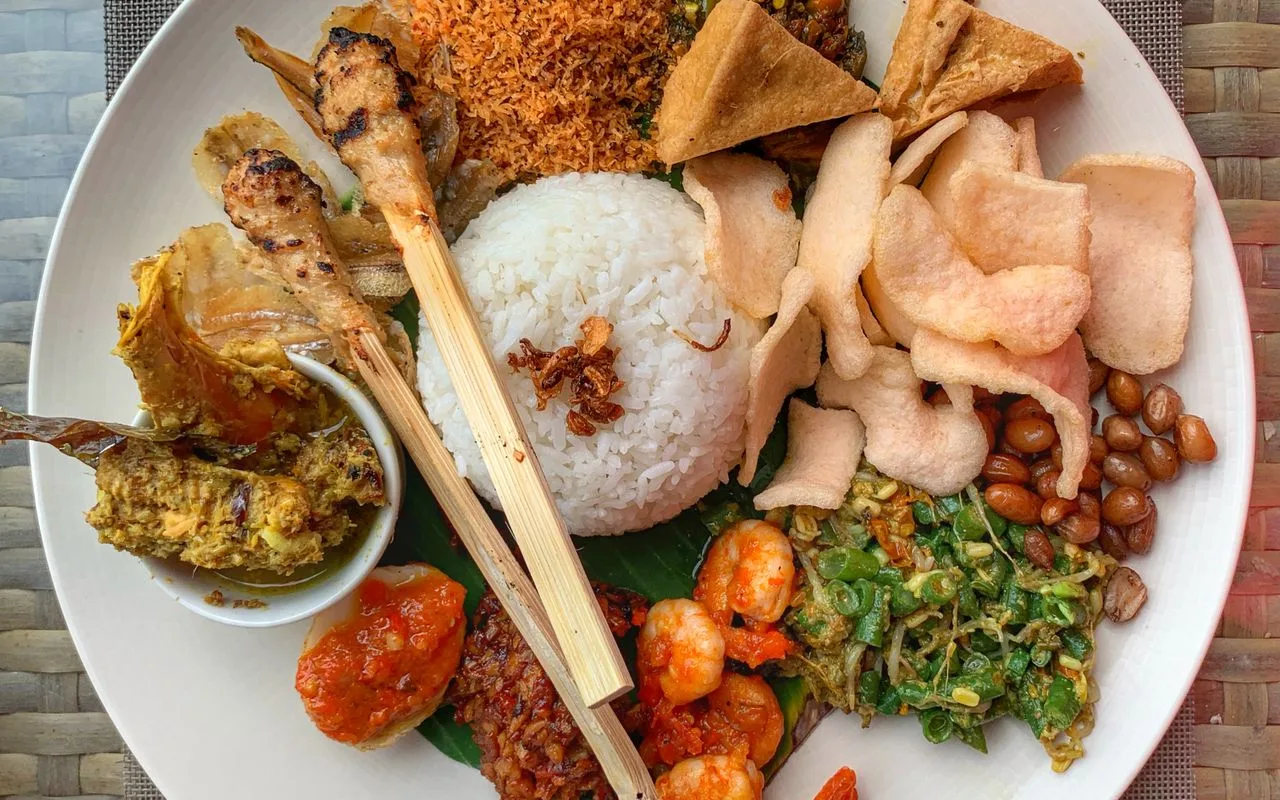
Forget the skewered cubes you know from elsewhere. Sate lilit is minced meat or fish blended with grated coconut, lime leaf and spice paste, then moulded by hand around a flattened bamboo or lemongrass stick and grilled over coconut husks. The fish version (often mahi-mahi or mackerel) is the classic, and the lemongrass stem perfumes the meat as it cooks.
This is the most approachable Balinese dish for nervous eaters — aromatic rather than punishingly spicy, and a brilliant snack with a cold drink. You’ll find it at warungs, at Jimbaran’s seafood grills a short drive from the villa, and on most nasi campur plates. A few sticks cost very little; a full plate with rice is around IDR 35,000–55,000.
Lawar — The Dish That Scares People (Unnecessarily)
Lawar is a fine-chopped salad of vegetables (often long beans or young jackfruit), grated coconut, minced meat and a long list of spices, bound together and seasoned with lime. There are two broad kinds: lawar putih (white, no blood) and lawar merah (red, traditionally bound with a little fresh pig’s blood for ceremonies). For everyday eating, the white version is what you’ll usually be served, and it’s genuinely delicious — herbaceous, crunchy, fragrant.
It rarely arrives as a standalone order; it’s the supporting act on a babi guling or nasi campur plate. If you have dietary concerns, simply ask whether it’s putih or merah — vendors are used to the question. Vegetarians can ask for lawar sayur (vegetable-only).
Nasi Campur — The Whole Island on One Plate
If you try only one thing, make it nasi campur (“mixed rice”). It’s a mound of rice ringed by small portions of everything: a little sate lilit, a spoon of lawar, shredded chicken, a fried peanut crunch, tempeh, an egg, greens and sambal. Every warung builds it differently, which makes comparing them half the fun.
This is the most efficient way to taste Balinese food — one IDR 30,000–60,000 plate gives you four or five dishes at once. It’s where we point new guests first, because a good local warung makan sits within a 10–15 minute drive of the villa. Point at what you want; the staff assemble it in front of you.
Jukut Ares & Other Comfort Dishes
Beyond the headliners, Bali has a quieter repertoire worth seeking. Jukut ares is a delicate soup made from the tender inner core of a banana stem, simmered with spices and sometimes pork or chicken — mild, soothing, and a window into village cooking. Alongside it you’ll meet plecing kangkung (chilli water-spinach), tum (spiced minced meat steamed in banana leaf parcels), be pasih mesambel matah (grilled fish with raw shallot-and-lemongrass sambal) and sambal matah itself, the bright raw relish you’ll want on everything.
These dishes show that Balinese food isn’t only about chilli and spit-roasting — there’s real subtlety here, balancing aromatic herbs, coconut and citrus. Ask your warung what the jukut (vegetable) of the day is; it changes with the market.
Jaja — Balinese Sweets & What to Drink
Balinese sweets, or jaja, are often coconut-and-palm-sugar affairs. Seek out klepon (green rice-flour balls that burst with liquid palm sugar), dadar gulung (pandan crepes rolled around sweet coconut), bubur injin (black-rice pudding with coconut milk) and pisang rai (steamed banana in grated coconut). They’re sold in markets, at ceremonies and as part of dessert spreads.
To drink: fresh young coconut (kelapa muda), es kelapa, the famous Kintamani coffee, and kopi Bali served strong and sweet. If coffee is your thing, our Kintamani coffee guide covers the highland plantations and the truth about luwak coffee. Round off any meal with a plate of tropical fruit — mangosteen, snake fruit (salak) and rambutan in season.
At a Glance: The Seven Dishes
| Dish | What it is | Spice level | Typical price (IDR) | Best eaten |
|---|---|---|---|---|
| Babi guling | Spit-roasted suckling pig with crackling | Medium–hot | 45,000–75,000 | Lunch, before 1pm |
| Bebek/ayam betutu | Slow-cooked spiced duck or chicken | Hot (ask to tone down) | 60,000–120,000 | Dinner; order bebek ahead |
| Sate lilit | Minced fish/meat satay on lemongrass | Mild–medium | 35,000–55,000 | Anytime; great by the beach |
| Lawar | Chopped veg, coconut & spice salad | Medium | part of a plate | As a side |
| Nasi campur | Rice with a sampler of everything | You choose | 30,000–60,000 | Lunch; best first taste |
| Jukut ares | Banana-stem soup | Mild | part of a plate | With a rice meal |
| Jaja | Coconut & palm-sugar sweets | Sweet | 5,000–25,000 | Snack or dessert |
A Few Notes on Eating Well & Safely
Balinese food rewards the adventurous, but a little knowledge helps. Spice (pedas) is real here; ask for tidak pedas or sedikit pedas (a little spicy) and the kitchen will adjust. Busy warungs with high turnover are usually the safest bet for freshness — if locals queue, you should too. Carry small cash; many warungs don’t take cards. Tap water is not for drinking, but bottled water is everywhere and cheap.
- Halal travellers: skip babi guling and lawar merah; seek out ayam betutu, sate lilit ayam, and the many halal warungs — just ask “halal?”
- Vegetarians: ask for nasi campur vegetarian, lawar sayur, gado-gado, and tempeh & tofu dishes — Bali caters well thanks to its yoga crowd.
- Timing: babi guling is lunch-only; betutu suits dinner; sate lilit works any time.
What we arrange at Villa Soleil
From Villa Soleil in Nusa Dua, we can book a private driver to the babi guling and betutu warungs locals actually eat at, or arrange a private cooking class and a chef-cooked Balinese feast in the villa kitchen; for a few days that weaves food between beaches and temples, see our 5-day Bali itinerary. Message the Villa Soleil team on WhatsApp to set it up.
Related reading
- Where to eat near the villa: Nusa Dua restaurants
- Learn to cook it: Bali cooking class guide
- Seafood by the sea: Jimbaran sunset dinner
- What to drink: Kintamani coffee guide
Written by the team at Villa Soleil. Message us to plan your stay in Nusa Dua.