Ubud Sacred Monkey Forest: A Focused Visitor’s Guide
By Villa Soleil · Published August 2026 · 7 min read
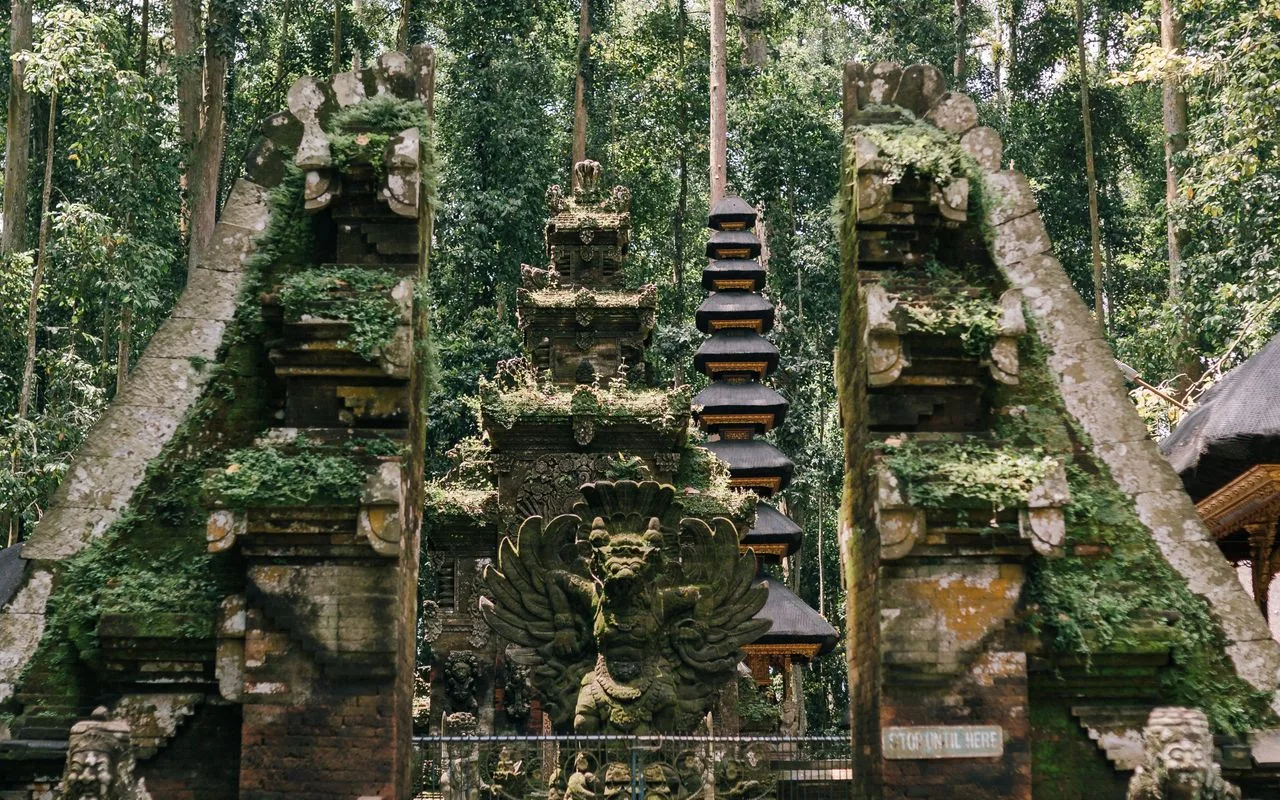
The first thing you notice is the sound — a rustle overhead, then a long-tailed macaque dropping onto the path a few feet ahead, utterly unbothered by you. The Sacred Monkey Forest, known locally as Mandala Suci Wenara Wana, is a genuine working temple complex set inside a cool, dense lowland jungle, home to roughly 1,200 Balinese long-tailed macaques living across several troops. It is not a zoo and not a petting park; it is a sanctuary where the monkeys are wild, the temples are still actively used, and you are a visitor on their turf. That single distinction shapes how you should plan and behave.
From Villa Soleil in Nusa Dua, the forest is around 40–45 km and a 1.5–2 hour drive depending on traffic through Denpasar and Sukawati. Because it sits right at the southern end of Jalan Monkey Forest, it pairs perfectly with the rest of central Ubud — the Royal Palace and the Art Market are a flat 10–12 minute walk north. This guide stays focused on the forest itself and how to slot it into an easy Ubud half-day. For the wider region, see our Ubud day trip guide.
What the Sacred Monkey Forest actually is
The site spans about 12.5 hectares of nutmeg and banyan forest, threaded with paved and stone paths, a deep ravine, a small river, and a footbridge. It is owned and managed by the local village of Padangtegal, which treats it as a place of spiritual, economic and educational importance. The macaques are considered sacred guardians, and the trees themselves are protected. You will hear the troops before you see them: the rustle of branches, the occasional shriek of a dominance dispute, and the soft chatter of mothers and infants.
Three temples sit within the grounds, each tied to the Balinese concept of balance between humans, nature and the divine. The forest is a living example of Tri Hita Karana, the philosophy of harmony that underpins Balinese Hinduism. For context on the religious side before you go, our Bali temple guide and cultural etiquette articles are worth a quick read.
The macaques: how to read them and stay safe
The long-tailed macaques here are clever, food-motivated and completely habituated to people — which is exactly why you need rules. They are not aggressive by nature, but they are opportunists. A monkey that grabs your sunglasses is not attacking you; it has learned that shiny objects can be traded back for fruit by the staff. Understanding that takes the fear out of it and tells you precisely what to protect.
- Remove your glasses — prescription and sunglasses both. They are the single most-grabbed item. Tuck them deep in a zipped bag.
- No loose items — hats, hair clips, earrings, dangling phone straps, water bottles sticking out of side pockets, and especially plastic bags (monkeys assume they hold food).
- Do not bring food or drink in, and never carry snacks in your pockets. The forest sells appropriate feed; outside food is discouraged and invites trouble.
- Do not feed them by hand unless staff guide you, and never tease or hold food back — that is what triggers a grab or a nip.
- Avoid eye contact and never smile widely. Bared teeth read as a threat in macaque body language. Stay calm, keep moving, lower your gaze.
- Do not touch the babies — mothers are protective, and the troop reacts fast.
- If a monkey climbs on you, stay still and let a ranger help. Do not flail or run.
If something is taken, walk calmly to a uniformed staff member; they recover items routinely. Bites do happen occasionally — if you are scratched or nipped, wash with soap and water and see a clinic, as rabies precautions are standard in Bali. Our host can point you to the nearest reliable clinic if needed.
Protecting your belongings — a quick checklist
Most bad experiences come down to one loose object. Here is the simple way to walk in “clean.”
| Item | Risk level | What to do |
|---|---|---|
| Sunglasses / glasses | Very high | Remove before entering; zip away |
| Hats & hair clips | High | Take off; carry inside bag |
| Plastic bags | Very high | Leave in the car — they signal “food” |
| Phone | Medium | Wrist strap or firm two-hand grip; no selfies up close |
| Water bottle | Medium | Keep zipped inside, not in a side pocket |
| Earrings / jewellery | Medium | Remove dangling pieces beforehand |
| Snacks / fruit | Very high | Do not bring any; pockets included |
A small cross-body bag that fully zips, worn at the front, is ideal; backpacks worn loosely are easy targets. Simplest of all, leave anything you do not need in the car with your driver and walk in with empty pockets.
The temples inside the forest
The complex holds three sanctuaries, and although the inner sanctums are reserved for worshippers, the architecture, moss-covered guardian statues and dramatic stairways are open to admire from the paths.
- Pura Dalem Agung Padangtegal — the main temple, dedicated to Shiva in his role as recycler of life. Look for the dramatic Rangda carvings and the towering split gate (candi bentar).
- Pura Beji — the “holy spring” temple in the ravine, used for ritual purification, set beside the river and reached by a mossy stone stair.
- Pura Prajapati — associated with funerary rites and the nearby cremation ground.
Modest dress is appreciated throughout, and you may not enter the temple interiors. The moss-draped stone, banyan roots curling over walls, and the dragon-bridge stairway draw most of the cameras — just keep your phone gripped firmly.
Tickets, hours and what to expect
Tickets are bought at the entrance (card and cash accepted). At the time of writing, adult entry is around IDR 80,000 and children roughly IDR 60,000, with under-threes usually free. The forest generally opens around 8:30am and closes mid-to-late afternoon, with last entry well before closing. Allow 60–90 minutes for an unhurried loop.
The best time to arrive is right at opening. The air is cooler, the light through the canopy is beautiful, the monkeys are active but calmer after their morning feed, and you beat the tour-bus crowds that build from around 10am. Wear closed shoes with grip — the stone paths are often damp and slick. A light rain layer is wise in the wet season (roughly November–March); see our best time to visit guide for seasonal planning.
Combining the forest with central Ubud
The forest’s location makes a tidy half-day. Walk north up Jalan Monkey Forest and within 10–12 minutes you reach the cultural core:
- Ubud Royal Palace (Puri Saren Agung) — free to wander the courtyards; arrive early for photos before crowds, or return in the evening for a traditional dance performance.
- Ubud Art Market (Pasar Seni) — directly opposite the palace; good for sarongs, baskets, woodcarving and souvenirs. Bargain politely and expect to settle around half the opening price. Our shopping & souvenirs guide has tips.
- Cafes & warungs along Jalan Dewi Sita and Jalan Hanoman for lunch after your walk.
A natural rhythm: forest at opening, palace and market mid-morning, lunch, then either head back to Nusa Dua or continue to the rice terraces north of town. If you want a full day, a cooking class or rice-terrace stop pairs beautifully — our Bali cooking class guide covers the options near Ubud.
Getting there from Nusa Dua
Plan on a 1.5–2 hour drive each way, and accept that Ubud traffic is genuinely unpredictable. A private driver who knows the back roads saves real time and frustration, and lets you leave anything you do not want to carry locked in the car while you explore. Riding a scooter this far with bags is not something we would recommend. For the full breakdown of options, costs and driver rates, see our Bali transportation guide.
What we arrange at Villa Soleil
For guests of Villa Soleil we arrange a private, air-conditioned car with an English-speaking driver who handles the Nusa Dua timing, the parking near the forest entrance, and the route through the palace and market so the half-day flows. Message the Villa Soleil team on WhatsApp the day before to set it up.
Related reading
- Ubud day trip from Nusa Dua
- Bali temple guide & etiquette
- Bali shopping & souvenirs
- Getting around Bali
Written by the team at Villa Soleil. Message us to plan your stay in Nusa Dua.