Galungan and Kuningan in Bali, explained for visitors
By Villa Soleil · Published September 2026 · 8 min read
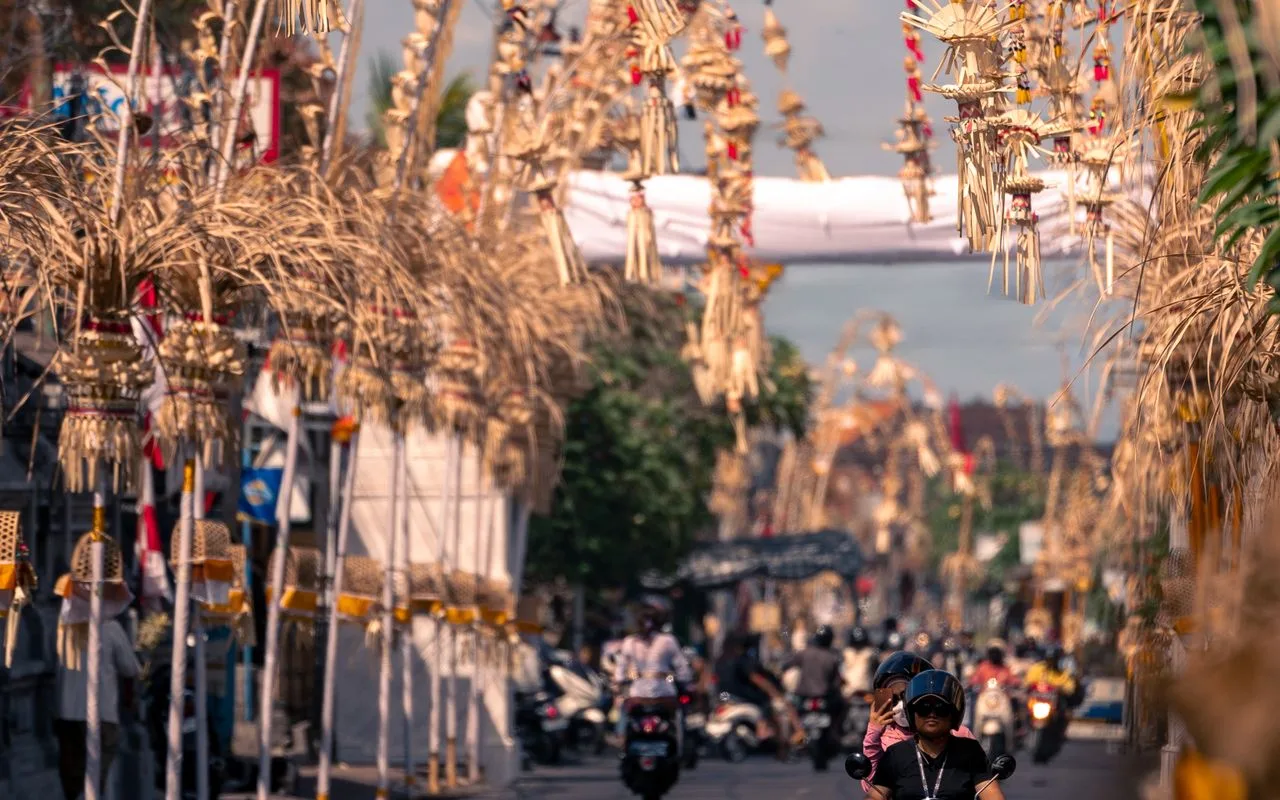
Quick answer: Galungan marks the victory of good over evil and the ancestors’ visit to the family home; Kuningan, ten days later, marks their return. Both follow the 210-day Pawukon calendar, so they fall once or twice a year — check a current Bali (Pawukon) calendar such as kalenderbali.org, or ask our host for dates. Bali does not close: hotels, flights and Nusa Dua run as normal, but family-run shops shut, drivers are scarce on the morning itself, and temples prioritise ceremonies. Wear a sarong and sash, stay behind those praying, and never touch a penjor.
- What Galungan and Kuningan actually mean
- The 210-day cycle, explained without a calculator
- Penjor: the bamboo poles that turn every street into a cathedral
- Day by day: what happens across the period
- What changes for visitors, honestly
- How to witness it respectfully
- Where to go from Nusa Dua during the cycle
- Planning a stay around Galungan
Every 210 days, Bali changes overnight. Bamboo poles taller than the houses bow over the roads, family shrines glow with fresh offerings, and the staff who normally greet you at breakfast are at their village temples in white and gold. This is Galungan, followed ten days later by Kuningan — the closest thing the island has to Christmas and a family reunion rolled into one, except it happens once or twice a year and the ancestors are the guests of honour. If your stay at Villa Soleil overlaps with the cycle, you are fortunate rather than inconvenienced. This guide explains what you are seeing, what quietly changes for visitors, and how to be a welcome witness rather than an awkward one.
What Galungan and Kuningan actually mean
Galungan celebrates the victory of dharma (order, virtue) over adharma (chaos, disorder). In the Balinese Hindu understanding it is also the moment the deified ancestors descend to visit their family compounds, where they are welcomed with offerings, prayers and a very good meal. Kuningan, ten days later, marks their return to the heavens. The whole cycle is therefore less a public spectacle than an extended family gathering with the departed — which is precisely why the most moving scenes happen inside house compounds and village temples rather than in the tourist zones.
The name Kuningan relates to the word kuning, yellow: families prepare nasi kuning, turmeric-tinted rice, as a symbol of prosperity and gratitude. Prayers on Kuningan traditionally finish before noon, because the blessings are believed to be present only until the sun reaches its zenith. Turn up at a temple at 2 pm on Kuningan and you will find the ceremony over and the family at lunch.
The 210-day cycle, explained without a calculator
Galungan does not follow the Gregorian year. It runs on the Pawukon, a 210-day calendar built from 30 named weeks of seven days each. Galungan always falls on the Wednesday of the eleventh week, a day called Buda Kliwon Dungulan; Kuningan always falls on the Saturday of the following week, Saniscara Kliwon Kuningan. Because 210 days is shorter than a solar year, the pair arrives about 1.7 times per calendar year — some years once, other years twice.
The most recent cycle fell on 17 and 27 June 2026. Published Bali calendars list the next two Galungan days as Wednesday 13 January 2027 (Kuningan Saturday 23 January) and Wednesday 11 August 2027 (Kuningan Saturday 21 August), but calendars are printed by several publishers and details occasionally differ, so check a current Bali (Pawukon) calendar such as kalenderbali.org, or ask our host before you build a trip around it. Our Bali festivals calendar shows how Galungan sits alongside Nyepi and the island’s other fixed and moving holidays.
Penjor: the bamboo poles that turn every street into a cathedral
The penjor is the most visible sign that Galungan is near. Each household erects a tall bamboo pole beside its gate, bent at the top under the weight of young coconut leaves, rice stalks, fruit, cakes and woven palm ornaments. The curve is deliberate: it evokes Mount Agung, the island’s holiest mountain, and the produce hanging from it gives thanks for the earth’s abundance. At the base sits a small shrine, the sanggah penjor, where offerings are placed daily through the period.
Penjor go up on Penampahan Galungan, the day before Galungan, and stay standing at least until Kuningan; in many villages they remain until the cycle formally closes some weeks later. Families spend anywhere from around IDR 150,000 for a modest home-made penjor to several million rupiah for the elaborate, professionally made versions you will see outside hotels and along the main streets of Ubud — worth remembering when you feel the urge to grab one for a photo. Look, photograph from the road, but do not lean on or handle them.
Day by day: what happens across the period
The festival is a sequence rather than a single day. Here is the shape of it, and what a visitor staying in Nusa Dua is likely to notice.
| Day | When | What Balinese families do | What you will notice |
|---|---|---|---|
| Penyekeban | Sunday, 3 days before | Bananas are sealed in clay pots to ripen for offerings | Markets busy; little visible change |
| Penyajaan | Monday, 2 days before | Making jaja, the coloured rice cakes for offerings | Sweet smells from village kitchens |
| Penampahan Galungan | Tuesday, 1 day before | Pigs are slaughtered, lawar is made, penjor are raised | Penjor appear overnight; staff may leave early |
| Galungan | Wednesday | Temple prayers from dawn, family visits, feasting | Local shops shut, quiet roads early, traffic near temples later |
| Manis (Umanis) Galungan | Thursday | Visiting relatives, outings, ngelawang barong processions | Beaches and parks busy with local families |
| Penampahan Kuningan | Friday, 9 days after | Preparing offerings and nasi kuning | Markets busy again |
| Kuningan | Saturday, 10 days after | Prayers before noon; tamiang and endongan offerings | Morning closures; normal by afternoon |
| Manis Kuningan | Sunday | Rest, family time, some village festivities | Island back to its usual rhythm |
What changes for visitors, honestly
Bali does not shut down for Galungan the way it does for Nyepi. Flights, fast boats and the airport run as normal, hotels and beach clubs stay open, and the ITDC enclave at Nusa Dua keeps its usual rhythm because its workforce is rostered around the holiday. What you will notice is everything run by a Balinese family: warungs shuttered for the day, the neighbourhood laundry closed, your favourite massage therapist away, and fewer drivers available on Galungan morning. Banks and government offices in Bali observe it as a regional holiday, so plan visa extensions and money changing for other days.
- Drivers: book at least two days ahead, expect a slightly higher price on Galungan and Kuningan, and accept a later start — most drivers pray with their families first. A full-day car with driver around south Bali typically runs IDR 650,000–900,000; confirm current rates.
- Traffic: roads near village temples and around Ubud clog from mid-morning; Ubud, already 1.5–2 hours from Nusa Dua, can take longer.
- Food: tourist restaurants open; small warungs may not. Villa Soleil’s private chef service can be arranged in advance for the days you would rather not go out.
- Temples: the big visitor temples such as Uluwatu remain open, but ceremonies take priority. You may be asked to wait or to keep to the outer courtyards.
- Spa and tours: operators run with reduced staff. Reconfirm bookings the day before rather than assuming.
How to witness it respectfully
The Balinese are generous about visitors at ceremonies, but generosity is not the same as an invitation to wander in. A few rules make the difference. Wear a sarong and sash to enter any temple — rent one at the gate for around IDR 10,000–30,000, or buy your own at a market for IDR 50,000–150,000 and keep it for the trip. Never stand higher than the priest or the offerings; stay behind or beside those who are praying, never in front. Do not step over offerings placed on the ground, and treat the canang sari on the pavement as what they are. Women who are menstruating are asked, by custom, not to enter temples. Ask before photographing people at prayer, and put the camera away entirely when the priest rings the bell for the main prayer. Our cultural etiquette guide and temple guide go deeper on all of this.
The best way to see Galungan properly is through a person, not a ticket. Ask our host: staff at the villa are often glad to explain what their own family is doing, and with notice a driver can take you to his village on Manis Galungan to watch ngelawang, the roaming barong procession in which children carry the lion-like guardian from gate to gate to chase away bad spirits in exchange for small donations. Have IDR 10,000–20,000 notes ready; giving is expected and appreciated.
Where to go from Nusa Dua during the cycle
You do not have to drive far. The villages of Bualu and Peminge, just behind the Nusa Dua enclave, put up superb penjor, and the lanes down towards Geger Beach pass small temples where morning prayers are visible from the road. Tanjung Benoa’s main street becomes a penjor gallery in its own right, a short stroll from the villa. For something grander, Ubud and its surrounding villages (1.5–2 hours) are the classic choice on Manis Galungan; Penglipuran, the heritage village near Bangli (around 2–2.5 hours), is lined end to end with penjor and welcomes visitors for an entry fee of IDR 50,000 per foreign adult (Indonesian nationals pay less; cash or QRIS only) — confirm current rates. Dance performances continue through the period, and our guide to Balinese dance helps you read what you are watching.
Planning a stay around Galungan
If the cycle falls during your dates, book drivers and day trips before you arrive, schedule your spa day and big restaurant night for the Manis days rather than Galungan itself, and give the villa team a little more lead time than usual for chef bookings. A private villa is a good base for this particular holiday: close enough to see real village life on foot, yet you sleep somewhere the ceremonies do not start at 5 am. Message the Villa Soleil team on WhatsApp at +62 877 7000 1535 (wa.me/6287770001535) with your dates and they will tell you whether Galungan overlaps, what will be open, and what they can arrange. Booking direct also gets you better rates than the OTAs.
Related reading
- Bali Festivals Calendar: Nyepi, Galungan and Moving Holidays
- Nyepi in Bali: The Day of Silence for Visitors
- Balinese Cultural Etiquette: Temples, Offerings and Dress
- Penglipuran Village: Bali's Best-Kept Traditional Village
Written by the team at Villa Soleil. Message us to plan your stay in Nusa Dua.