Bali Festivals & Ceremonies: A Year-Round Calendar for Travellers
By Villa Soleil · Published July 2026 · 8 min read
- How the Balinese calendar works
- Galungan & Kuningan: the island dressed in penjor
- Nyepi: Bali’s Day of Silence
- Saraswati & the days around it
- Bali Arts Festival & kite season (June–August)
- Temple odalan: the ceremony you’re most likely to stumble upon
- Festival calendar at a glance (2026)
- Etiquette: how to be a welcome guest at a ceremony
- What we arrange at Villa Soleil
Drive out of the gate at Villa Soleil on almost any morning and you will pass women in lace kebaya balancing towers of fruit on their heads, lanes laced with curved bamboo poles, and incense drifting from a family compound. Bali runs on two overlapping calendars and a near-constant rhythm of ceremony, so the question for a traveller is not “will there be a festival?” but “which one falls during my stay, and how do I watch it respectfully?” This guide walks through the island’s major festivals month by month, what you can actually see as a visitor, and the etiquette that keeps you a welcome guest rather than an intrusion.
How the Balinese calendar works
Bali uses two traditional calendars alongside the familiar Gregorian one. The pawukon is a 210-day cycle that governs many temple anniversaries and holidays such as Galungan, Kuningan and Saraswati — which is why those dates shift each Gregorian year and, in most years, fall twice in twelve months. (2026 is an unusual exception: the cycle drifts so that Galungan lands only once, in June.) The saka calendar is lunar and sets Nyepi, the Balinese New Year, in March. Layered on top are thousands of individual temple anniversaries called odalan, each pura celebrating its own birthday every 210 days. The practical takeaway: there is almost always something happening somewhere, and the biggest island-wide events follow the pawukon and saka cycles rather than fixed Western dates.
Galungan & Kuningan: the island dressed in penjor
If you only learn two festival names, make them Galungan and Kuningan. Galungan marks the victory of dharma (good) over adharma (evil) and the period when ancestral spirits return to visit their families. For roughly ten days the entire island is decorated with penjor — tall, gracefully curved bamboo poles hung with palm leaves, rice and fruit that arch over every street, including the lanes around Nusa Dua and Benoa. Kuningan, ten days later, is when the spirits return to the heavens; families make special yellow rice offerings in the morning, so ceremonies tend to wrap up by midday.
For visitors, this is mostly a family-and-temple affair rather than a public street party, but you are very welcome to admire the penjor, watch processions from a respectful distance, and visit temples that are open. In 2026 Galungan falls just once, on Wednesday 17 June, with Kuningan ten days later on Saturday 27 June — an unusual single-occurrence year, so June is the standout month for penjor-lined streets. Shops, drivers and staff often take time off to be with family, so plan transport ahead; we can usually line up a driver who is happy to work through the holiday.
Nyepi: Bali’s Day of Silence
Nyepi is unlike any other holiday on earth. For 24 hours the whole island shuts down: no flights in or out of Ngurah Rai airport, no traffic, no shops, no lights at night, and for many, no talking or eating. It is a day of self-reflection that marks the Balinese New Year in the saka calendar, usually in March (Nyepi 2026 falls on Thursday 19 March). The night before is the opposite of silence — the Ngrupuk parade fills the streets with enormous, grotesque ogoh-ogoh monster effigies carried by torchlight to drive out evil spirits.
As a guest this is a genuinely special experience if you embrace it. At Villa Soleil you stay put for the day, enjoy the pool and the quiet, and look up at a sky with no light pollution at all. Because no one may leave their accommodation and the airport is closed, never schedule arrival or departure on Nyepi. We dig deeper into the dos, don’ts and how to prepare in our dedicated Nyepi guide; for the cultural ground rules that apply all year, see our Bali cultural etiquette guide.
Saraswati & the days around it
Saraswati honours the goddess of knowledge, learning and the arts. On this day books, manuscripts and sacred texts are blessed, and you will see students and families bringing offerings to schools, libraries and temples. It is gentle and beautiful rather than dramatic, but worth knowing about because of what follows: Banyu Pinaruh the next day, a purification ritual where Balinese bathe in the sea and at holy springs at dawn. The beaches near Nusa Dua — including Geger, a ten-minute walk from the villa — can see lovely early-morning gatherings. Saraswati follows the pawukon cycle, so in most years it occurs more than once a Gregorian year.
Bali Arts Festival & kite season (June–August)
If your trip lands in the dry season, you are in luck — and June is the richest month of all. The Bali Arts Festival (Pesta Kesenian Bali) runs from mid-June to mid-July at the Taman Werdhi Budaya arts centre in Denpasar — roughly 45–60 minutes from Nusa Dua depending on traffic. It opens with a parade and then offers a month of dance, gamelan, theatre and craft from every regency on the island. Because Galungan (17 June 2026) falls squarely inside this window, June pairs the island’s headline temple festival with its biggest arts event — a strong month for authentic Balinese performing arts, and most events are free or very inexpensive.
The same dry-season winds bring kite season. From roughly June through August, giant traditional layang-layang kites — some many metres across, flown by whole village teams — fill the skies, especially over open fields and the Sanur/Padang Galak area. The international Bali Kite Festival is the headline event. It pairs naturally with a day on the east coast; our Sanur day trip guide covers the easy run up there from the villa. To pair festival days with everyday sightseeing, our things to do in Nusa Dua guide is a good companion.
Temple odalan: the ceremony you’re most likely to stumble upon
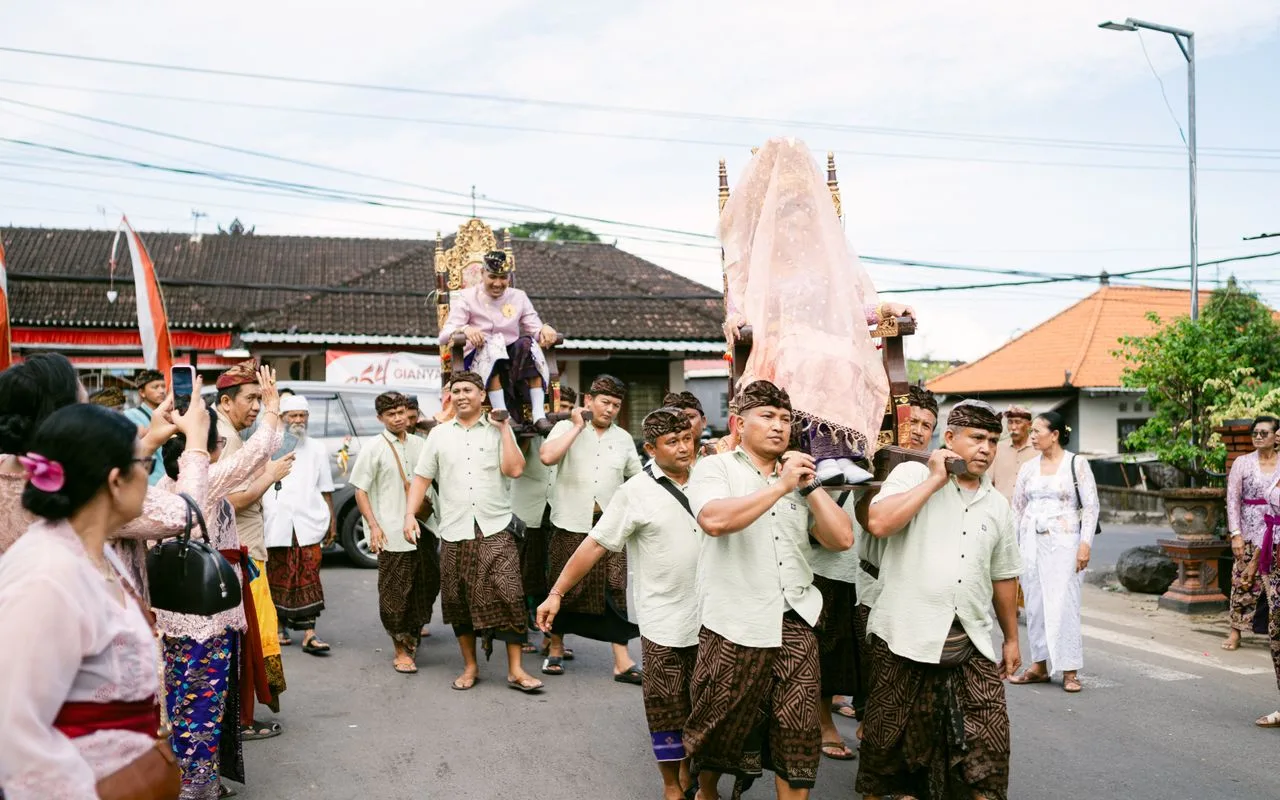
Beyond the headline festivals, the ceremony you are likeliest to come across is an odalan — a temple’s anniversary celebration, held every 210 days at each of Bali’s tens of thousands of temples. You may simply round a corner and find a pura alive with offerings, gamelan music, dancers and worshippers in full temple dress. Odalan are open to respectful visitors as long as you observe the rules: wear a sarong and sash (often available to borrow at the entrance), keep to the back, do not point your feet at shrines, never stand higher than a priest, and ask before photographing people mid-prayer. Women who are menstruating traditionally do not enter temple grounds during ceremony.
Because odalan dates are spread across the calendar, your host is often the best source for which temples near Nusa Dua — or along your planned route — are holding ceremony during your stay.
Festival calendar at a glance (2026)
Approximate timing for the main events; pawukon-based festivals (Galungan, Kuningan, Saraswati) usually fall twice a year, though in 2026 Galungan lands only once — confirm exact dates before you travel.
| Festival | 2026 timing (approx.) | What a traveller sees |
|---|---|---|
| Galungan | Wed 17 June (once in 2026) | Penjor lining every street, family temple visits |
| Kuningan | Sat 27 June (10 days after Galungan) | Morning yellow-rice offerings, processions |
| Nyepi (New Year) | Thu 19 March | Ogoh-ogoh parade the eve; total silence the day |
| Saraswati & Banyu Pinaruh | Varies (pawukon) | Blessing of books; dawn sea purification |
| Bali Arts Festival | Mid-Jun to mid-Jul | Month of dance, gamelan & craft in Denpasar |
| Kite season | Jun–Aug | Giant kites over Sanur & open fields |
| Temple odalan | Year-round | Local temple anniversary, offerings & dance |
Etiquette: how to be a welcome guest at a ceremony
Balinese people are remarkably gracious about sharing their religious life with respectful outsiders, and a little courtesy goes a long way. A few essentials:
- Dress modestly — sarong and sash for temples, shoulders covered. Keep a sarong in your day bag during festival season.
- Watch processions from the side; never cut across or walk in front of people who are praying.
- Do not step over or kick the small palm-leaf offerings (canang sari) on the pavement — walk around them.
- Ask before photographing individuals, and avoid using flash or standing above worshippers.
- Drive slowly and patiently behind processions; they always have the right of way.
- If invited to join, accept graciously and follow your host’s lead — it is a genuine honour.
These same principles apply when you visit Bali’s temples on ordinary days, and our broader cultural etiquette guide covers tipping, dress and temple conduct in more depth.
What we arrange at Villa Soleil
Send us your travel dates and your host will check which pawukon and saka events overlap your stay, then tell you what you can see — from penjor-lined lanes before Galungan to a nearby odalan or the Arts Festival in Denpasar — and arrange a driver who knows which temples welcome visitors. Message the Villa Soleil team on WhatsApp to set it up.
Related reading
- Bali Cultural Etiquette Guide
- Balinese Traditional Dance
- Best Time to Visit Bali
- Things to Do in Nusa Dua
Written by the team at Villa Soleil. Message us to plan your stay in Nusa Dua.