Bali in January: Rain, Lower Prices and an Honest Verdict
By Villa Soleil · Published November 2026 · 8 min read
- What January weather in Bali really looks like
- The post-New Year lull: crowds and prices
- Sea and surf conditions by coast
- Rain-proof plans within fifteen minutes of the villa
- Best day trips that month
- Festivals in January: Galungan and Kuningan in 2027
- Practical notes for a wet-month stay
- Our honest verdict
January is, statistically, the wettest month of the Bali year, and we would rather you heard that from us than discovered it at the airport. It is also the month when the Christmas crowds thin, villa and restaurant prices soften, and the island exhales. Whether that trade-off works for you depends on the kind of holiday you want. Below is the honest picture from our side of the Bukit: what the rain actually does, how the sea behaves coast by coast, what to do when the sky opens, and which day trips still make sense from Villa Soleil in Benoa.
What January weather in Bali really looks like
The long-term normals for Ngurah Rai airport, a short drive from the villa, put January at roughly 350 mm of rain spread over about 19 rain days, the highest of any month. December is close behind at around 300 mm; November is nearer 150 mm. Those figures come from the 1991–2020 climate period and individual years swing widely, so treat them as a shape rather than a promise.
What the numbers miss is the rhythm. A typical January day in the south starts hazy and humid, builds heavy cloud through the afternoon, then delivers a hard, warm downpour for one to three hours before clearing into a still evening. Mornings are the reliable window for the pool, the beach and any drive worth taking. The exception is the handful of days each January when a larger monsoon system parks over the island and it rains, more or less, all day for two or three days. In late January 2026, for instance, the BMKG weather agency issued an island-wide severe-weather warning for a full week, with waves forecast up to 4 m on the crossings. Daytime highs sit around 31°C and nights around 24°C, so the villa air-conditioning earns its keep. For the broader season, our rainy-season guide covers the mechanics in more depth.
The post-New Year lull: crowds and prices
The first week of January is still peak. Australian school holidays run until late in the month, but many families leave after the first weekend, and Indonesian domestic travellers head home once the New Year holiday ends. From roughly the second week, Nusa Dua noticeably quietens: restaurant tables that needed booking in December become walk-in, the lagoon in front of the resorts empties, and drivers have more availability at fairer rates.
Pricing follows the same curve. Villa Soleil starts from IDR 4,500,000 per night for the whole four-suite house, sleeping eight, and outside the Christmas and New Year window that base rate is what you actually pay rather than a starting point beneath a peak surcharge. Book direct with our host on WhatsApp and you will do better than the same dates through an online travel agency, because there is no commission in the middle. Flights from Australia, Singapore and Europe also drop sharply after the first week, which is often the biggest saving of all.
Sea and surf conditions by coast
The wet-season wind comes from the west and south-west. That single fact decides everything about the water in January: it blows onshore on the Bukit’s famous west-facing reefs and offshore along the east coast, so the good surf and the calmest swimming both shift to our side of the island.
| Coast | January sea | Surf | Our take |
|---|---|---|---|
| Nusa Dua & Benoa lagoon | Reef-protected, calm in the morning, choppier after lunch; some seaweed and storm debris after big rains | Nusa Dua reef works on the offshore westerlies for confident intermediates | The best swimming and paddle-boarding on the island this month |
| East coast: Sanur, Serangan, Keramas | Glassy dawns, offshore wind, brown run-off near river mouths after storms | The wet-season surf heartland; Keramas is the standout right-hander | Worth the 20–25 min drive to Serangan for a morning session |
| Bukit west: Uluwatu, Padang Padang, Bingin | Onshore and messy most afternoons, occasional clean early windows | Crowds thin, quality drops; still surfable at dawn | Go for the cliffs, the temple and sunset, not the waves |
| Crossings to Nusa Penida & Gili | BMKG high-wave warnings of 2.5–4 m are common; fast boats are suspended at short notice | Not applicable | Plan as a bonus, never as the trip’s centrepiece |
Visibility for snorkelling and diving is the other casualty. River run-off clouds the water close to shore, so if you are set on a dive, ask the operator about conditions the day before and be ready to move the date.
Rain-proof plans within fifteen minutes of the villa
One of the quieter arguments for Nusa Dua in January is that the ITDC enclave was built for exactly this weather. Eight to ten minutes by car from the villa you have:
- Museum Pasifika (ITDC area, open daily 10:00–18:00): more than 600 works from Indonesia, the Pacific and the foreign artists who painted Bali in the 1930s, in air-conditioned rooms. Entry is around IDR 100,000; confirm current rates.
- Devdan Show at the Bali Nusa Dua Theatre: a 90-minute dance-and-acrobatics production every Monday, Wednesday, Friday and Saturday at 19:30, with tickets from around IDR 520,000 in the cheapest category; confirm current rates.
- Bali Collection for covered shopping, a supermarket, cafes and a dry afternoon when the villa starts to feel small.
- In-villa spa: our host books therapists who come to the villa for IDR 250,000–450,000 per hour, which on a stormy afternoon beats any treatment room.
- A private chef dinner for the evening the rain arrives at seven and nobody wants to get in a car.
Cooking classes in Jimbaran or Ubud, batik and silver workshops, and a long lunch on a covered terrace all work regardless of the sky. We keep a fuller list in our rainy-day activities guide, and the honest advice is to plan one indoor anchor per day and let the mornings decide the rest.
Best day trips that month
The rule is to leave early and be back, or under cover, by mid-afternoon. With that in mind, these are the trips we would still book in January.
Jimbaran and the Bukit (20–45 min). Jimbaran seafood is 20–30 minutes away, Uluwatu temple 35–45 minutes. The kecak fire dance at the temple is open-air, so on a threatening evening choose Jimbaran instead; the beach-grill restaurants have roofed sections and a stormy sunset over the bay is its own show.
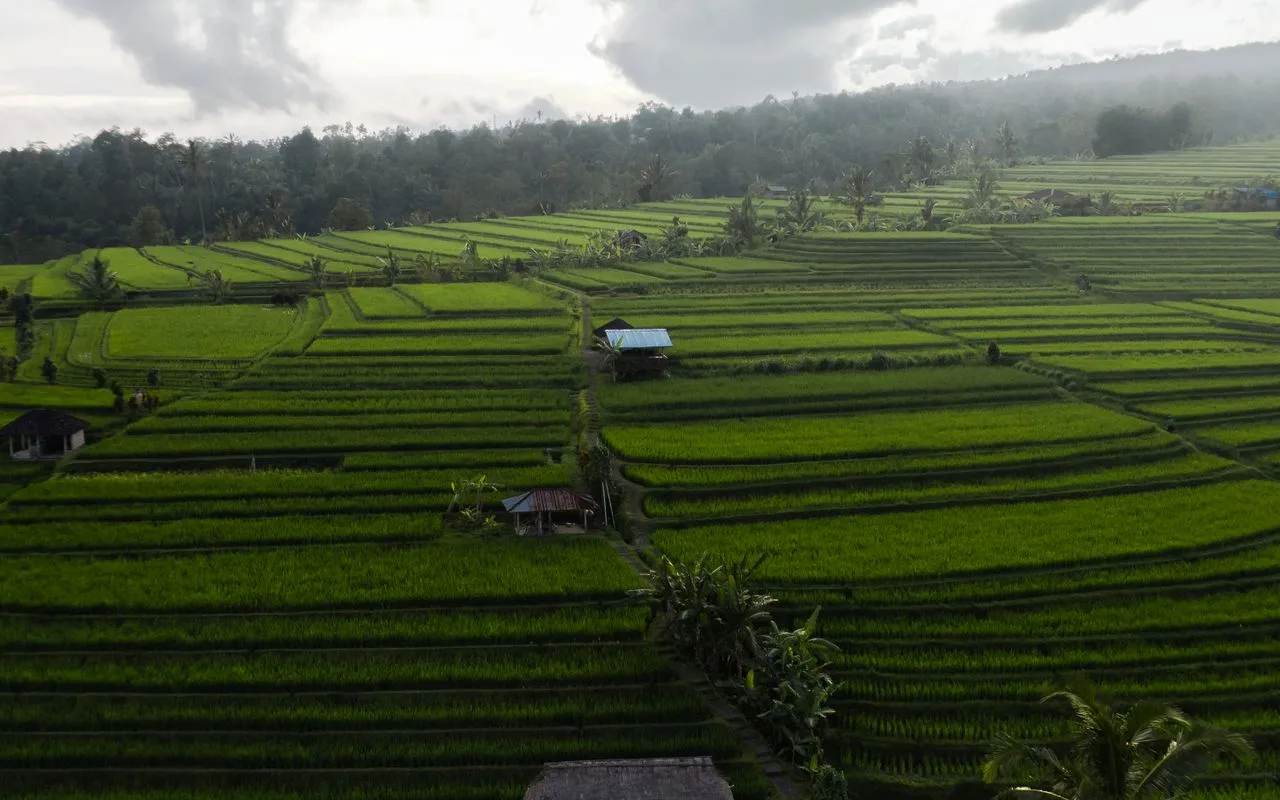
Ubud (1.5–2 h). The rice terraces look their most alive in January: the paddies are flooded and the young rice is coming through, so the valleys are a patchwork of water and fresh green. Palaces, the Ubud market and the museums are all workable in rain. Leave the villa by 7:00 and you get a dry morning at Tegallalang before the traffic and the cloud build.
Sidemen (1.5–2 h). Quieter than Ubud, with the same lush wet-season valleys and far fewer coaches. Good for a slow lunch in a rice-field restaurant.
What we would skip: the big inland waterfalls after heavy rain, when Sekumpul in the north, Tukad Cepung in Bangli and Tegenungan near Ubud run brown and dangerously fast; Mount Batur sunrise, which is a cloud lottery at this time of year and a 2.5–3 hour drive each way; and anything that depends on a fast boat.
Festivals in January: Galungan and Kuningan in 2027
Balinese ceremonies follow a 210-day calendar, so Galungan lands in a different Gregorian month each cycle. In 2027 it falls in January: Galungan on Wednesday 13 January 2027, and Kuningan, which closes the ten-day period, on Saturday 23 January 2027. The cycle then repeats in August 2027. Always check the official Balinese calendar before planning around it. In the days before Galungan, every village raises tall bamboo penjor over the road, and on the day itself many family-run warungs, drivers and staff take time off for temple visits. It is a beautiful time to be here and a slightly slower one for getting things done; read our Galungan and Kuningan guide for the etiquette. There is no Nyepi in January, and the Nusa Dua Fiesta has not historically been a January event, so check the ITDC calendar if you want to be sure.
Practical notes for a wet-month stay
Every foreign tourist pays the IDR 150,000 Bali tourist levy once per visit, ideally in advance on the official Love Bali portal (lovebali.baliprov.go.id) rather than the copycat sites. Mosquito activity peaks in the wet season and dengue cases with it: use repellent at dusk, sleep under the air-conditioning and let us know if anyone develops a fever, because BIMC Siloam Nusa Dua sits inside the ITDC enclave about ten minutes away. Pack a light rain shell, quick-dry sandals with grip for wet temple steps, and one extra set of clothes per person for the day the afternoon storm catches you out. A private car with driver for a ten-hour day runs IDR 700,000–1,000,000 depending on distance, and in January that is money well spent: scooters, flooded lanes and tropical downpours are a poor combination. Buy travel insurance that covers weather disruption, because flight delays and boat cancellations are ordinary January events.
Our honest verdict
Come in January if you want the island quieter and cheaper, if your idea of a good day includes a long breakfast, a morning swim in a calm lagoon and an afternoon reading under a roof while the rain drums on the pool, and if you can hold day trips loosely. Do not come in January if this is your one shot at Bali and the non-negotiables are Nusa Penida, waterfalls in full sun and Bukit surf at its best. For families, couples and groups of friends who value privacy over sunshine guarantees, a four-suite house with its own pool is exactly the right shape of holiday for a wet month, and Villa Soleil was built for lazy, rain-interrupted days. Message our host on WhatsApp with your dates and we will tell you plainly what the month is likely to do.
Related reading
- Christmas and New Year in Bali
- Bali in November
- Best time to visit Bali
- Mosquito and dengue tips for Bali
- Year-End School Holidays in Bali with Kids: What to Expect and What to Book — How busy Bali really gets over the year-end school holidays
- Uluwatu Weather and Surf: Season, Swell and Tide Explained — Uluwatu works on a southeast wind through the dry season
Written by the team at Villa Soleil. Message us to plan your stay in Nusa Dua.