Canang Sari: Bali’s Daily Offerings, Explained
By Villa Soleil · Published October 2026 · 9 min read
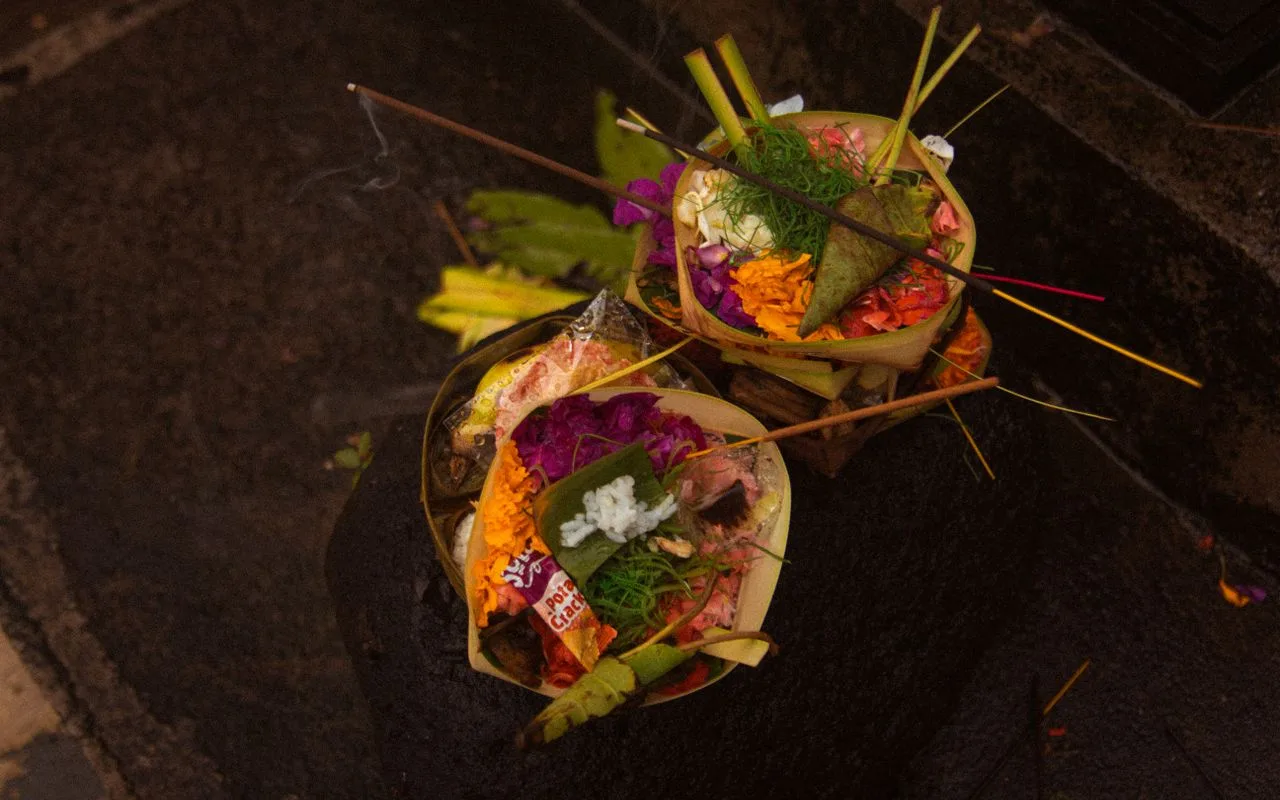
Quick answer: Canang sari are small palm-leaf offerings of betel (porosan), flowers, pandan and incense that Balinese Hindus place every morning at shrines, doorways and workplaces as daily thanks and balance. They are everywhere because ordinary life, not just temple days, needs maintaining. Step around them, never on or over them, and do not touch the contents. The idea underneath is Tri Hita Karana: harmony with God, with people and with nature.
Within an hour of arriving in Bali you will have stepped around one. A palm-leaf square the size of your palm, a scatter of petals, a curl of incense smoke, sitting on a shop step, a car dashboard, a shrine, the pavement outside a bank. These are canang sari, the small daily offerings that Balinese Hindus lay out every morning, and once you know what you are looking at, the island reads differently. This guide covers what is in one, why they are everywhere, how to walk past them, the daily rhythm behind them, and the idea of Tri Hita Karana that explains why a family spends real money and time on something swept away by afternoon.
What a canang sari actually is
The name is simple: canang is the small woven tray, sari means essence. The tray itself is folded from young coconut leaf (janur) and pinned with slivers of bamboo. Inside sits a set of ingredients that look decorative but are each doing a job:
- Porosan — a betel leaf wrapped around a smear of lime and a sliver of areca nut. This is the ritual core; the three ingredients stand for the Tri Murti of Brahma, Wisnu and Siwa. Without it a canang is just a pretty tray.
- Flowers by direction — white to the east, red to the south, yellow to the west and blue or green to the north, each colour tied to a deity of that compass point. In practice you will often see frangipani, marigold, hydrangea and whatever the garden gave that morning.
- Kembang rampe — finely shredded pandan leaf on top, for fragrance and, in the classic reading, for wisdom.
- A small extra — a biscuit, a boiled sweet, a pinch of rice, a coin, even a cigarette. Practical gifts for whoever the offering is meant to please.
- Incense (dupa) and a sprinkle of water — the smoke carries the essence upward; the water blesses it.
The offering is considered received once the incense has burned down. What is left on the ground afterwards is, in Balinese terms, a spent vessel. That distinction matters for the etiquette section below.
Why they are everywhere
Bali is the only Hindu-majority province in Indonesia, and Balinese Hinduism weaves ancestor worship, nature spirits and Indian-derived theology into a single daily practice. Offerings are not reserved for temple days; they are the ordinary maintenance of good relations with the seen and unseen world. A household compound alone might place a dozen canang each morning: at the family shrine, the gate, the kitchen, the well, the motorbike. Add the shop, the warung, the office desk and the taxi dashboard, and the numbers across the island run into the millions every day.
Where the canang is placed tells you who it is for. Offerings lifted up onto shrines and altars are for the gods and deified ancestors. Offerings on the ground, often at gateways, crossroads and thresholds, are for the bhuta kala, the lower spirits and rough energies that need to be kept content rather than worshipped. That is why you see them on the pavement: nobody has dropped them there by accident. For the wider context of shrine types and temple layout, see our Bali temple guide.
The daily rhythm behind the offerings
The routine usually belongs to the women of the household, though men and children join for bigger days. It starts before breakfast. Some families make their canang from scratch the evening before, sitting together to fold janur, a craft called mejejaitan. Many more now buy them ready-made from the morning market or from a neighbour who makes them for a living; in the villages behind Nusa Dua and Benoa you will see women carrying stacked trays on their heads at first light.
After cooking, before anyone eats, a tiny pinch of cooked rice is set out on a scrap of banana leaf at key points around the compound; this is mesaiban, a separate, even humbler offering. Then the canang go out, each with incense lit, a flower dipped in water and flicked over the tray, and a small wave of the hand (ngayab) to waft the essence towards its recipient. The circuit might take fifteen to thirty minutes; shops repeat a smaller version at opening time and often again at dusk.
| Moment | What happens | What you will notice |
|---|---|---|
| Dawn to ~8am | Household and shop offerings placed, incense lit | Smoke and fresh petals on every threshold; women in sarong and sash |
| Midday | Offerings considered spent; sweeping begins | Old canang piled by the roadside or in bins |
| Dusk | Many homes and businesses place a second round | Fresh incense outside restaurants and villas |
| Kajeng Kliwon (every 15 days) | Extra offerings at gateways and crossroads for the bhuta kala | More ground-level canang, sometimes with a little rice wine |
| Purnama & Tilem (full and new moon) | Temple visits and larger tiered offerings | Processions, temple bells, family groups in white |
| Galungan & Kuningan (210-day cycle) | Ten days of ancestor celebration; penjor poles line the roads | The island at its most decorated; check the official calendar for dates |
Etiquette: how to walk past one
Stepping on a canang is not a crime, and nobody will shout at you, but it reads as careless, much like walking across a freshly raked grave. A few simple habits are enough:
- Look down on steps and thresholds. Shop entrances, temple gateways and pavement corners are where offerings sit. Step around them, never on or over them.
- Never kick or move one aside, even on a narrow footpath. A clearly spent one matters less, but the habit of care is what locals notice.
- Do not touch, pick up or take anything from an offering. The coin is not lost change and the biscuit is not a snack.
- Give space to someone placing one. If a staff member is mid-prayer at a doorway, wait a few seconds rather than pushing past.
- Photograph respectfully. Offerings themselves are fair game. People at prayer are not, unless you have asked with a smile and a gesture.
- If you do step on one by accident, a quiet apology to whoever is nearby is plenty. Balinese people are pragmatic about this; intention counts.
The same logic extends to temples and ceremonies, where the rules on dress, menstruation and where to stand are more formal. Our Bali cultural etiquette guide covers those in detail.
Tri Hita Karana: the idea underneath
Ask a Balinese friend why all of this matters and sooner or later you will hear the phrase Tri Hita Karana, roughly “the three causes of well-being.” It describes harmony on three fronts: parahyangan (people and God), pawongan (people and each other) and palemahan (people and nature). The phrase itself was formalised in the mid-20th century, but the ideas behind it are far older, and they are the reason a canang ends up on a motorbike as well as a shrine. The bike is part of the household’s relationship with the material world; keeping that relationship in balance is as much a religious duty as prayer.
The concept is not abstract. UNESCO inscribed Bali’s subak rice-irrigation landscape on the World Heritage list in 2012 specifically as a manifestation of Tri Hita Karana, because the water temples, farmer cooperatives and terraced fields are a working system built on the same three-way balance. The village council (banjar), the temple calendar and the daily canang express the same idea at different scales; the incense on a bank doorstep and the terraces at Jatiluwih are one argument about how to live.
What it costs, and who makes them
The offering economy is real. A ready-made canang at a local market sells for something in the region of IDR 1,000–3,000 apiece, with bundles of ten typically running IDR 10,000–30,000 depending on size, flowers and location; prices climb around Galungan when demand spikes and flower supply tightens, so treat those as rough figures and confirm current rates locally. Multiply by a dozen a day, plus incense, and a modest household spends a noticeable slice of its budget on ceremony; the metre-high fruit towers (gebogan) of festival days involve days of labour and far larger sums.
Making canang is also a livelihood. Thousands of women, many of them older, weave and sell trays from home or market stalls, and the trade in janur, flowers and incense supports growers island-wide. If you want to try it yourself, several cultural centres and some villas run short offering-making sessions, usually an hour or two, often bundled with a cooking class or a temple visit; expect roughly IDR 150,000–450,000 per person and confirm what is included. It is fiddly, humbling and the quickest way to appreciate the skill in something you have been stepping around all week.
Seeing it well from Nusa Dua
You do not need to go to Ubud for this. The resort strip of Nusa Dua sits on top of ordinary Balinese villages, and Benoa and Bualu have their own temples, morning markets and daily routine. A 7am walk through the lanes behind the ITDC area, or along the Tanjung Benoa beach road before the water-sports crews set up, shows the whole cycle: women with trays, incense on every gate, the smell of pandan and clove. Pura Geger, the small clifftop temple above Geger Beach about ten minutes by car, is a quiet place to watch offerings being made at a shrine rather than a shopfront; dress modestly and stay outside the inner courtyard unless invited.
Staying at Villa Soleil puts you inside this rhythm rather than beside it. Our team places the villa’s own canang each morning and will happily explain what they are doing, or show you how the janur is folded. Our host can also arrange a dawn market visit with a driver, or time a day trip to coincide with a temple festival; the Bali festivals calendar explains how the 210-day cycle works and why you should check the official dates rather than trust a printed list. Book direct for our best available rate, plus a WhatsApp reply within the hour on +62 877 7000 1535.
Related reading
- Bali Cultural Etiquette: Temples, Dress and Daily Manners
- Bali Temple Guide: How to Visit Respectfully
- Bali Festivals Calendar: Galungan, Kuningan and the 210-Day Cycle
- Nyepi in Bali: The Day of Silence Explained
Written by the team at Villa Soleil. Message us to plan your stay in Nusa Dua.