Serangan Island & the TCEC Turtle Conservation Centre
By Villa Soleil · Published November 2026 · 9 min read
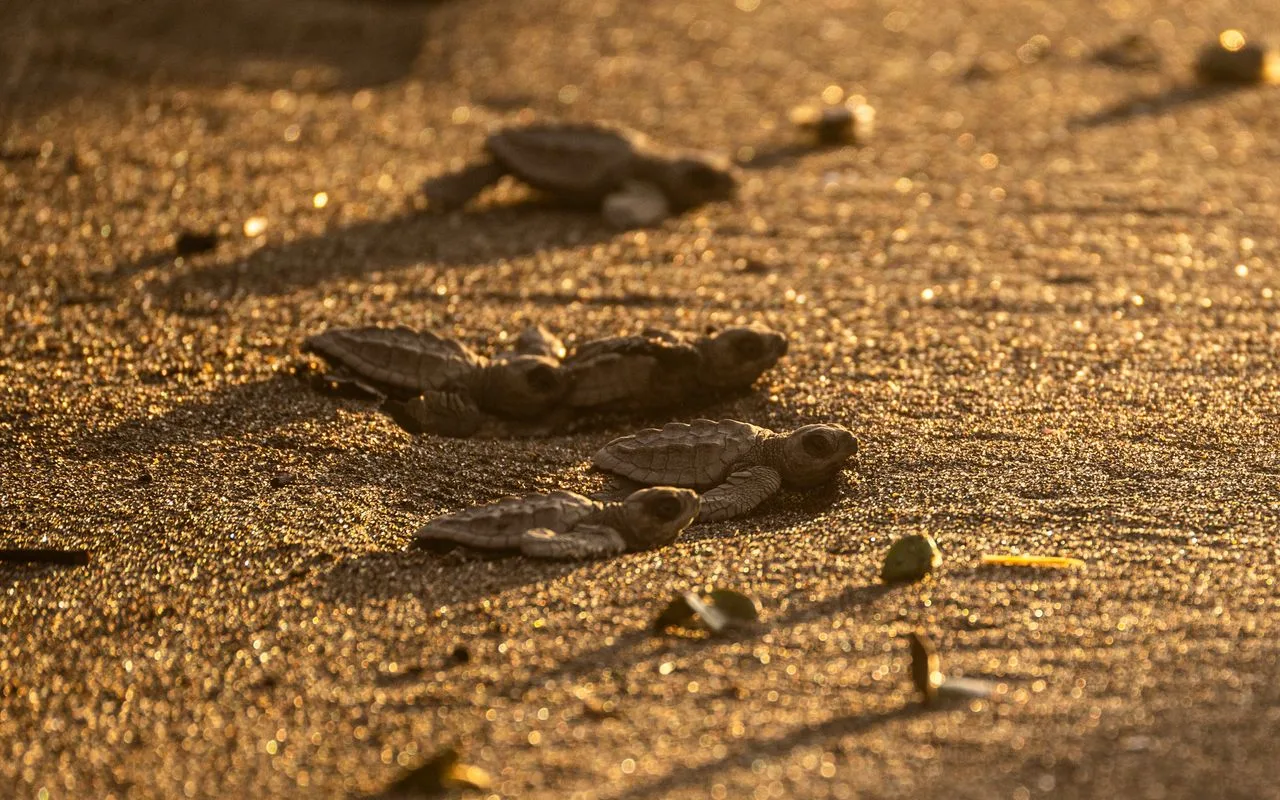
Quick answer: Serangan is 20–25 minutes by car from Villa Soleil. The TCEC turtle centre has no ticket: entry is by donation, parking is about IDR 5,000, and a symbolic hatchling adoption and release runs roughly IDR 150,000–250,000, but only in season, roughly April to October, and only when a clutch has hatched. Confirm current rates and availability by phone a day ahead, then add the 17th-century As-Syuhada mosque and Pura Dalem Sakenan for a two-hour loop.
- What TCEC actually is
- Fees, hours and how a visit runs
- Ethical turtle release: seasons, cost and what to expect
- How Serangan differs from Tanjung Benoa’s Turtle Island
- Kampung Bugis and the As-Syuhada mosque
- Pura Dalem Sakenan and its 210-day pilgrimage
- Surf, mangroves and the rest of the island
- Is Serangan right for your family?
Serangan is the low, flat island you glimpse from the Bali Mandara toll road between Nusa Dua and Benoa Harbour, and most guests drive straight past it. That is a pity, because 20–25 minutes from Villa Soleil it holds one of the few places in south Bali where a turtle encounter is run as conservation rather than as a photo stop: the Turtle Conservation and Education Centre, usually shortened to TCEC. Add a 17th-century Bugis mosque, a coral-stone temple that draws thousands of pilgrims every 210 days, a boat-access reef break and a fringe of recovering mangroves, and you have a half-day that feels nothing like the resort enclave you left behind.
What TCEC actually is
The Turtle Conservation and Education Centre opened in January 2006 on Jalan Tukad Punggawa, backed by WWF Indonesia, the provincial government and the Serangan community. Its origin story matters: until the early 2000s Serangan was infamous as the hub of Bali’s turtle trade, with animals landed here for meat and ceremonial use. TCEC was set up to give the island a legal, educational alternative, and it has quietly stuck to that job for two decades.
What you see today is deliberately modest. A cluster of concrete tanks holds turtles recovering from boat strikes, fishing-line injuries and confiscations from the black market, some with missing flippers that will never go back to sea. A shaded hatchery incubates eggs relocated from nests on nearby beaches, and nursery pools hold hatchlings for roughly a month before release. Three of the world’s seven sea-turtle species pass through here: green, hawksbill and olive ridley. In a recent year the team reported rescuing more than 7,600 eggs and releasing around 4,000 hatchlings, and the centre logged over 59,000 visitors in 2024, so it is small but hardly obscure.
Fees, hours and how a visit runs
There is no ticket. Entry is by donation, with a small parking charge of about IDR 5,000, and a volunteer or staff member will usually walk you through the tanks and explain each resident’s story. Budget 45–60 minutes for the standard visit; the site is compact, and a longer stay only makes sense if you are joining a release.
The centre generally opens around 9:00 and winds down by mid-to-late afternoon, with shorter hours reported at weekends. Because it is community-run rather than a commercial attraction, times do shift, so check the current Google Maps listing or ask our host to phone ahead the day before. Mornings are best: hatchlings are more active, the tanks are cooler and you will have the place largely to yourselves.
- Bring cash in rupiah for the donation box; card facilities are not something to rely on.
- Do not touch or lift turtles, and keep flash off around the hatchery.
- Ride-hailing pickups can be patchy on the island, so keep your driver waiting rather than gambling on a return car.
- Pair the visit with our Bali with kids notes if you are travelling with young children; the tanks are at toddler height and there is little shade between them.
Ethical turtle release: seasons, cost and what to expect
This is the part most guests ask about, and the honest answer is that a release cannot be booked like a table. Nesting on Bali’s beaches runs roughly from March or April to September, hatching and releases roughly April to October, and even within that window the centre only releases when a clutch has hatched and the sea is calm. Outside the dry season your chances drop sharply, and no reputable operator will promise one in January.
When hatchlings are ready, TCEC runs a symbolic adoption: you make a donation, receive a certificate, and carry a single hatchling to the tide line where it scrambles into the surf on its own. Recent visitor reports put the adoption donation at roughly IDR 150,000–250,000 per hatchling, sometimes with a short boat transfer added on top; confirm current rates when you call, as the figure is set by the centre and changes. The rules are simple and worth respecting: no holding the animal for photos, no placing it in the water yourself, and releases happen at dusk or in the cooler morning, never under a midday sun for convenience.
If you want the release to be the centrepiece of the outing, ask our host to check availability a day or two ahead. If none is scheduled, the rehabilitation tanks and the hatchery are still worth the drive, and the donation still funds the same work.
How Serangan differs from Tanjung Benoa’s Turtle Island
A few minutes from the villa, the water-sports beach at Tanjung Benoa sells glass-bottom boat trips to what the brochures call Turtle Island, the Deluang Sari pen on the mangrove side of the peninsula. Packages start at about IDR 150,000 per person, the boat ride over the seagrass beds is genuinely pleasant, and children like it. Its weakness is what happens on arrival: adult turtles in shallow concrete pools are lifted out for photos, and the compound also keeps caged birds, snakes and other animals in conditions that draw regular complaints. It is a wildlife photo stop, not a conservation programme, and we cover it candidly in our Turtle Island Tanjung Benoa guide.
| Aspect | TCEC Serangan | Turtle Island, Tanjung Benoa |
|---|---|---|
| Purpose | Rescue, rehabilitation, hatchery and education since 2006 | Tourist attraction reached by glass-bottom boat |
| Cost | Entry by donation; parking about IDR 5,000; hatchling adoption roughly IDR 150,000–250,000 | Boat packages from about IDR 150,000 per person |
| Handling | No touching; hatchlings walk into the sea from the tide line | Turtles lifted for photos; other animals on display |
| Release possible? | Yes, seasonally, roughly April to October, when a clutch has hatched | Not the focus of the visit |
| Time from Villa Soleil | 20–25 minutes by car | Short drive to the beach, then a boat |
| Best for | Families who want the real thing and accept modest facilities | A quick boat ride; skip the turtle pen if welfare matters to you |
Kampung Bugis and the As-Syuhada mosque
Serangan is not only Hindu. On its northern shore, a few minutes from TCEC, Kampung Bugis is a settlement founded by Bugis seafarers from South Sulawesi who arrived in the 17th century and were granted land by the Badung royal house for their loyalty. Their mosque, Masjid As-Syuhada, still stands with its original teak pillars and tiered pulpit, is listed as a cultural heritage site, and keeps a handwritten Qur’an said to be some two centuries old. It is one of the oldest mosques in Bali and the oldest in Denpasar.
Visits are informal. Dress modestly, ask before photographing anyone, and avoid prayer times on Fridays. The village lanes around the mosque smell of smoked fish, a Serangan speciality, and the beach at low tide is a jumble of painted wooden boats resting on the mud. The Bugis and Balinese communities have shared this small island for centuries, and a mosque within sight of a major Hindu temple is a quiet lesson in how Bali actually works.
Pura Dalem Sakenan and its 210-day pilgrimage
On the north-western tip stands Pura Dalem Sakenan, one of Bali’s important sea temples. Its foundation is credited to the 10th-century priest Mpu Kuturan, and the 16th-century sage Dang Hyang Nirartha is also honoured here. The older shrines were built from coral and limestone quarried from the reef, which gives the compound a pale, weathered look unlike the volcanic stone of inland temples.
Its anniversary festival, the piodalan, falls on the Saturday of Kuningan every 210 days on the Balinese pawukon calendar and runs for three days. Until the 1996 reclamation, which joined Serangan to the mainland by causeway and expanded it to roughly 481 hectares, pilgrims waded across at low tide or came by jukung outrigger; today they arrive by car and motorbike in their thousands. If your stay overlaps with Kuningan, expect road closures around the temple and dress in full temple attire. Outside festival days the compound is calm, a sarong and sash are required, and a small donation is customary. Our temple guide covers the etiquette in detail.
Surf, mangroves and the rest of the island
Serangan’s reef break sits offshore and is usually reached by boat from the small harbour on the island, since the paddle out from the beach is long. It offers both lefts and rights over a coral platform, works best around mid-tide, and is at its most consistent in the wet season from November to March, when the westerly winds blow offshore on this side of the island and the crowd swells with it. Local boatmen charge around IDR 100,000 per person for a shared return run when there are enough surfers; surf-school packages with coaching and boat start from about IDR 1,000,000. The outer peaks are for confident intermediates, but the softer inside section is where south-Bali schools take improvers on bigger days. Absolute beginners should look at our beginner surf guide for gentler options.
The mangroves you pass on the causeway are part of the story too. The dredging of the 1990s smothered reef and killed much of the original forest, and replanting has been slow but visible. There is no polished boardwalk on Serangan itself; the calmer paddle is in the neighbouring Benoa mangrove channels, a short drive back toward the villa. The island’s eastern shore is being reshaped by the Kura Kura Bali special economic zone, with a marina and a public beach still called Pantai Serangan, so expect construction traffic on some approaches.
Is Serangan right for your family?
Yes, with expectations set. TCEC is a working rescue centre, not a marine park: no air-conditioning, no cafe, no guaranteed release. Children aged four and up tend to get the most out of it; they can see hatchlings at eye level and grasp why a turtle with a missing flipper stays behind. Combine it with the mosque and temple for a two-hour loop, then continue to Sanur for lunch or return to the villa pool by early afternoon. Our host can arrange a driver for the loop, typically IDR 350,000–500,000 for a half day including waiting time, and will phone TCEC first to check whether hatchlings are ready. Replies on WhatsApp usually come within the hour, and booking the villa direct gets you better rates than the OTAs.
Related reading
- Turtle Island, Tanjung Benoa: what to expect
- Kayaking the Benoa mangroves
- Sanur day trip from Nusa Dua
- Galungan and Kuningan in Bali
Written by the team at Villa Soleil. Message us to plan your stay in Nusa Dua.