ITDC Nusa Dua Guide: How the Gated Resort Enclave Works
By Villa Soleil · Published October 2026 · 8 min read
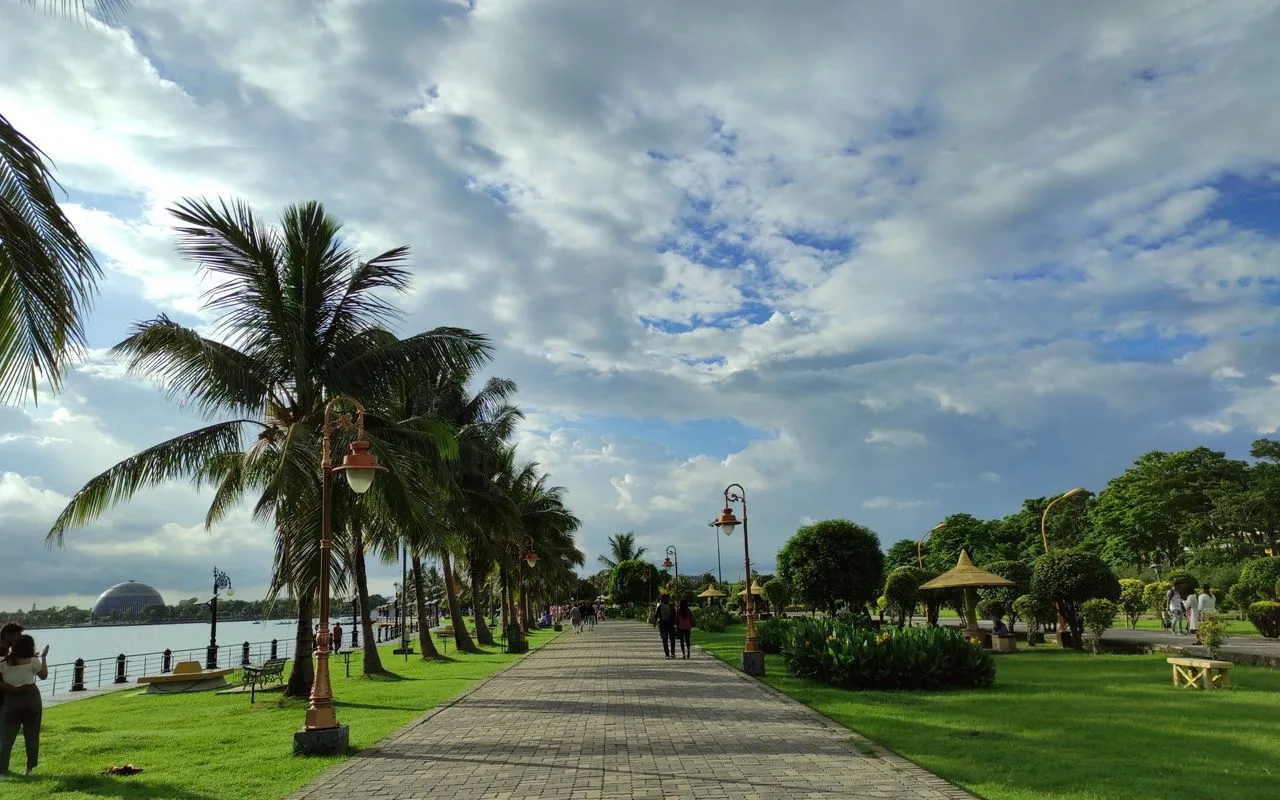
Quick answer: ITDC Nusa Dua is a roughly 350-hectare gated resort estate founded in 1973 (as BTDC) and managed by a state company. Anyone can enter free through its three 24-hour gates; guards simply ask where you are going. Inside are public beaches (free, parking IDR 2,000–5,000), Water Blow on Peninsula Island (IDR 25,000 adult, IDR 15,000 child for foreign visitors, IDR 15,000 and IDR 10,000 for Indonesians, cash or QRIS, 09:00–18:00), Bali Collection (10:00 until about 22:00–23:00) with a free hotel shuttle, Museum Pasifika and BIMC Siloam hospital. Villa Soleil in Benoa is 8–10 minutes by car from Bali Collection.
Ask a taxi driver to take you to “Nusa Dua” and there is a fair chance you will end up at a security barrier, a guard will lean in and ask which hotel you are going to, and you will realise that Nusa Dua is not really a town at all. It is an enclave: a planned, gated resort zone managed by a state-owned company called ITDC. We stay in Benoa, just outside its northern edge, and use the enclave almost daily for beaches, dinners, the pharmacy and the hospital. This guide explains what the ITDC zone is, who can enter it, what is actually inside, and how a villa guest gets the best of it without paying resort prices.
What ITDC Nusa Dua actually is
ITDC stands for Indonesia Tourism Development Corporation, today part of the InJourney state tourism holding. The company began life in 1973 as the Bali Tourism Development Corporation (BTDC), created after an Indonesian government and World Bank study looked for a way to bring large hotels to Bali without letting them sprawl across villages and rice fields. The answer was a 1972 master plan for roughly 350 hectares of dry, thin-soiled land on the Bukit peninsula’s eastern shore, to be developed as a single, landscaped resort estate. BTDC was renamed ITDC on 16 May 2014, and the zone itself is now marketed as “The Nusa Dua”.
Half a century on, the estate holds more than 20 starred hotels with roughly 5,500 rooms, a golf course, two convention centres (BICC and BNDCC), the Bali Collection shopping complex, Museum Pasifika, the Bali Nusa Dua Theatre and a private hospital, all connected by wide, tree-lined boulevards that are swept daily. It has hosted the 2007 UN climate conference, the 2013 APEC summit and the 2022 G20 leaders’ summit, which tells you how seriously the security is taken. The upside for ordinary visitors is a part of Bali with proper pavements, working streetlights, and traffic that moves.
Who can enter, and what the gate check involves
This is the question we get asked most, so the short version first: anyone can enter, entry is free, and you do not need to be staying in a hotel. The enclave is reached through three main gates, each staffed around the clock. At the barrier a guard will usually ask where you are heading. Naming a hotel, “Bali Collection”, “the beach” or “Water Blow” is enough. Cars are sometimes given a quick look with an undercarriage mirror and an occasional glance in the boot; motorbikes are usually waved through. The whole thing takes twenty seconds and nobody asks for ID or a hotel booking.
Three practical points from experience.
- Big hotels run their own second layer of security at their driveways, so a resort lobby is not automatically open to walk-ins; restaurants and spas that accept outside guests generally are.
- Scooters can enter, but a few hotels bar them from their forecourts; park in the public beach lots instead.
- During summits and state events some roads inside are closed for hours at a time; your driver will know, and the southern beaches stay reachable via Jalan Pantai Mengiat.
The public beaches inside the zone
Indonesian law keeps the shoreline public, and ITDC has kept several access lanes open between the hotels. The most useful is Jalan Pantai Mengiat at the southern end, which leads to a public car park and a stretch of sheltered sand that locals simply call Nusa Dua Beach or Mengiat Beach. There is no entrance fee; you pay only for parking, typically IDR 2,000 for a motorbike and IDR 5,000 for a car. Warungs sell grilled corn, coconuts and cold drinks, and the water inside the reef is calm enough for small children at mid to high tide. We cover the sand in more detail in our Nusa Dua beach guide.
Further south, beyond the zone’s formal boundary, Geger Beach is about 10 minutes by car from the villa and has the best swimming on this coast. Inside the zone you can also walk the beachfront promenade that runs from the Nusa Dua Beach Hotel area down towards Peninsula Island; hotel security will not stop you as long as you stay on the public path and the sand rather than wandering onto pool decks.
Peninsula Island and Water Blow
Peninsula Island is the larger of the two coral outcrops that give Nusa Dua (“two islands”) its name. It is a broad, grassy headland with a paved loop path, sea views on three sides and the only bit of dramatic coastline in an otherwise gentle bay. On its outer edge the Indian Ocean funnels into a narrow limestone cleft and explodes upwards: this is Water Blow, best seen at high tide with a decent swell, which in practice means the dry-season months from roughly July to October and any windy afternoon in the wet season. Entry is IDR 25,000 per adult and IDR 15,000 per child for foreign visitors (IDR 15,000 and IDR 10,000 for Indonesians), payable in cash or by QRIS, with the site open daily from 09:00 to 18:00; parking runs to IDR 5,000 for a motorbike and IDR 10,000 for a car. Bring a bag for your phone, because the spray reaches the viewing platform. We have a full page on timing your Water Blow visit.
Peninsula Island is also where ITDC stages its big annual party. It began in 1996 as the Nusa Dua Fiesta and is now billed as The Nusa Dua Festival: a weekend of parades, food stalls and evening concerts, usually in the second half of October. The 2025 edition ran on 25 and 26 October; dates shift each year, so check the events page on itdc.co.id before you plan around it.
Bali Collection and the free shuttle
Bali Collection is the enclave’s open-air shopping and dining complex, roughly 8 to 10 minutes by car from Villa Soleil. It is where villa guests go for a supermarket run, a pharmacy, an ATM, batik and homeware shops, and a row of restaurants that stay open later than most of Benoa. Opening hours are 10:00 until late evening, generally around 22:00 to 23:00 depending on the outlet. Prices are higher than in Benoa village but lower than resort menus. Our Bali Collection guide lists what is worth your time.
The free shuttle is a Bali Collection service, not a public bus. It runs a fixed loop through the hotels of Nusa Dua and Tanjung Benoa from about 10:00 to 21:00, with roughly hourly pick-ups; hotel guests ask their concierge for the timetable and wait at the lobby stop. Because the loop serves hotel driveways rather than private villas, guests at Kendi Mas Villa 2 cannot be collected at the door. In practice we either walk to the nearest hotel stop in Tanjung Benoa or book a Grab or Gojek car, which typically costs IDR 25,000 to 50,000 one way for the short hop; confirm the fare in the app before you tap. In November 2025 ITDC also trialled a free electric shuttle inside the zone linking Bali Collection, Museum Pasifika, the theatre and Peninsula Island from 09:00 to 22:00; it was a one-month pilot, so ask locally whether it is running.
Museum, theatre, golf and the hospital
Museum Pasifika, opposite Bali Collection, holds one of the region’s better collections of Asia-Pacific art in eleven cool, quiet rooms. It opens daily 10:00 to 18:00; tickets are IDR 100,000 for international visitors and IDR 70,000 for Indonesian residents, with children under 11 free. Next door, the Bali Nusa Dua Theatre stages Devdan, a 90-minute Indonesian dance-and-acrobatics show, a few evenings a week; see our Devdan Show guide for current nights and seat prices. Bali National Golf Club sits inside the zone but has been closed for a full refurbishment since 2025, with reopening scheduled for 2027. And at the heart of the estate is BIMC Siloam Nusa Dua, a private hospital with a 24-hour emergency department, which for us is the single most reassuring thing about staying in this corner of the island.
ITDC Nusa Dua at a glance
| Place | Hours | Cost | From Villa Soleil |
|---|---|---|---|
| Enclave gates | 24 hours, 3 main gates | Free entry | A few minutes by car |
| Mengiat / Nusa Dua public beach | Daylight hours | Free; parking IDR 2,000–5,000 | About 10 min by car |
| Water Blow, Peninsula Island | 09:00–18:00 | IDR 25,000 adult, IDR 15,000 child (foreign visitors); IDR 15,000 adult, IDR 10,000 child (Indonesians); cash or QRIS; parking IDR 5,000–10,000 | About 10 min by car |
| Bali Collection | 10:00 until about 22:00–23:00 | Free entry | 8–10 min by car |
| Free hotel shuttle | About 10:00–21:00 | Free, hotel stops only | Walk to nearest hotel stop |
| Museum Pasifika | 10:00–18:00 | IDR 100,000 international, IDR 70,000 domestic | 8–10 min by car |
| BIMC Siloam Nusa Dua | 24-hour emergency | Private hospital | About 10 min by car |
Fees and hours change; treat these as a planning guide and confirm current rates on the day.
How we use the enclave from the villa
Staying at Villa Soleil in Benoa means you get the enclave’s order without the resort bill. A typical day for our guests looks like this: a swim in the private pool, a walk to the beach 650 metres away, then a driver into the zone for a late lunch at Bali Collection and a wander along the promenade to Peninsula Island for the afternoon blow. Evenings are for a chef dinner at the villa or a table at one of the hotel restaurants that welcome outside guests, and a ride home that takes under ten minutes. Our host arranges drivers, a private chef and babysitters over WhatsApp on +62 813 090 112 and answers within the hour; book direct for better rates than the OTAs. If you are still weighing Nusa Dua against the west coast, the short answer is that the enclave trades nightlife for calm water, safe pavements and an early night, and most families we host decide that is exactly the trade they wanted.
Related reading
- Water Blow Nusa Dua: when to go and what to expect
- Bali Collection Nusa Dua: shopping, dining and the shuttle
- Museum Pasifika: Asia-Pacific art inside the enclave
- Things to do in Nusa Dua beyond the resorts
- Conferences and Events at BNDCC Nusa Dua — Halls, parking, where a delegation of eight sleeps
- Golf in Nusa Dua & Bali — Golf near Nusa Dua in 2026: Bali National is closed for refurbishment
- Renting a Villa in Nusa Dua and Benoa: Neighbourhoods, Prices and What to Check — How to rent a villa in Nusa Dua and Benoa: neighbourhoods
- Nusa Dua Fiesta: The Nusa Dua Festival, Explained for Villa Guests — Nusa Dua Fiesta, now The Nusa Dua Festival: October timing, the parade
- Accessible Bali: A Wheelchair & Limited-Mobility Guide from Nusa Dua — An honest guide to wheelchair-friendly Bali: airport help
Written by the team at Villa Soleil. Message us to plan your stay in Nusa Dua.