The Bali Coffee Trail & Kintamani Highlands Day Trip
By Villa Soleil · Published June 2026 · 9 min read
- Why Kintamani is Bali’s coffee country
- The drive up from Nusa Dua
- Coffee plantations & agrotourism: what actually happens
- The honest truth about kopi luwak
- Mount Batur caldera & lake views
- Combining with Tegallalang, Tirta Empul & Ubud
- What to buy & how to bring it home
- What we arrange at Villa Soleil
There is a particular kind of morning that Bali does better than almost anywhere: cool air at altitude, mist lifting off a volcanic caldera, and a small cup of coffee grown on the slope you are looking at. That is the promise of the Kintamani highlands, and it is one of the most rewarding day trips our guests take from Villa Soleil. This is not the pre-dawn Mount Batur summit hike — that is a different adventure entirely, covered in our guide to the Mount Batur sunrise trek. This is the gentler, later-starting cousin: a coffee-and-views day built around plantations, tastings, and the spectacular rim of the caldera, all at a civilised pace.
Why Kintamani is Bali’s coffee country
Most of the coffee you will drink at sea level in Bali is robusta, grown in the lowlands and prized for its punch. Kintamani is different. Sitting roughly 1,200 to 1,500 metres above sea level on the flanks of the Batur volcano, the highland air is cool, the volcanic soil is rich, and the conditions suit arabica — the more delicate, higher-acidity bean that coffee lovers chase. Kintamani arabica even carries a protected Geographical Indication, recognising its distinctive bright, citrus-and-floral character that comes partly from the local practice of inter-planting coffee with citrus trees.
For our guests this means two things. First, the coffee here is genuinely good and genuinely local — not a tourist gimmick. Second, the journey up takes you through some of the most beautiful terraced and forested country on the island, the temperature dropping pleasantly with every hundred metres you climb. By the time you reach the rim, you may want the light sweater we always suggest in our Bali packing list.
The drive up from Nusa Dua
From Villa Soleil in Nusa Dua, Kintamani is roughly 60 to 70 km north, and you should budget 2 to 2.5 hours each way depending on traffic through Denpasar and Ubud. The smart move is to leave by 8 or 8.30am, before the worst of the mid-morning jams, so you reach the highlands while the air is still crisp and the clouds have not yet rolled over the volcano. A private car with driver is by far the most comfortable option for a day like this; the roads climb and wind, and you will want to nap on the way home. We explain the full picture of getting around in our Bali transportation guide.
A typical loop strings together a plantation tasting, the caldera viewpoint for lunch, and one or two cultural or scenic stops on the way back down through the Ubud region. Because so much of the route passes through central Bali, this trip combines beautifully with sights you might otherwise visit on a separate day.
Coffee plantations & agrotourism: what actually happens
The classic Kintamani (and upper-Ubud) experience is the agrotourism plantation, or agrowisata. These small estates welcome visitors for a walk through the gardens and a tasting flight, and the good ones are a genuine pleasure. Here is what a visit usually involves:
- A garden walk. A guide shows you coffee shrubs, cacao pods, vanilla vines, and spice plants — turmeric, ginger, lemongrass, butterfly-pea flower — often with fruit to taste straight off the branch.
- The roasting demonstration. You will usually see green beans hand-roasted in a wok over a wood fire, then ground with a pestle and mortar. It is theatrical, but it is also how a lot of village coffee is genuinely made.
- The tasting flight. The heart of the visit. Expect a tray of small cups: several coffees and herbal teas to sample for free — Bali coffee, ginseng coffee, coconut coffee, lemongrass tea, ginger tea, hibiscus, chocolate, and so on. The famous kopi luwak is almost always the one cup you pay extra for.
- The shop. Every tour ends in a small shop. There is no obligation to buy, and prices are higher than a supermarket — but a bag of single-origin Kintamani arabica is a lovely, genuinely useful souvenir.
The free tasting is the reason these stops are so popular, and it is a low-pressure way to spend 30 to 45 minutes. Our concierge can point you to estates our guests consistently enjoy rather than the bus-tour conveyor belts.
The honest truth about kopi luwak
We have to be straightforward here, because it is the one part of the coffee trail that troubles many thoughtful travellers. Kopi luwak is coffee made from beans that have passed through the digestive system of the Asian palm civet (the luwak). In the wild, civets are nocturnal animals that selectively eat the ripest cherries, and traditionally farmers gathered these droppings from the forest floor — a rare, labour-intensive product.
The problem is the modern industry. Soaring demand has led many operations to cage civets and force-feed them coffee cherries in cramped, stressful conditions. Animal-welfare groups have documented serious problems: tiny wire cages, poor diet, stress behaviours, and high mortality. Caged-civet coffee is also, by most accounts, not even better — the stressed animals eat indiscriminately, undermining the very selectivity that made wild kopi luwak special.
Our honest advice to guests is simple. If you want to taste it once out of curiosity, ask directly and clearly: are the civets wild-sourced or kept in cages? If you see small cages with visibly stressed animals, walk away — do not buy, and do not pay for the tasting. There are estates that source only wild droppings, or that simply do not deal in kopi luwak at all and let their excellent arabica speak for itself. Honestly, you will not be missing much: a well-made cup of Kintamani arabica is, to most palates, the more delicious drink. Treating animals well and drinking great coffee are not in conflict here.
Mount Batur caldera & lake views
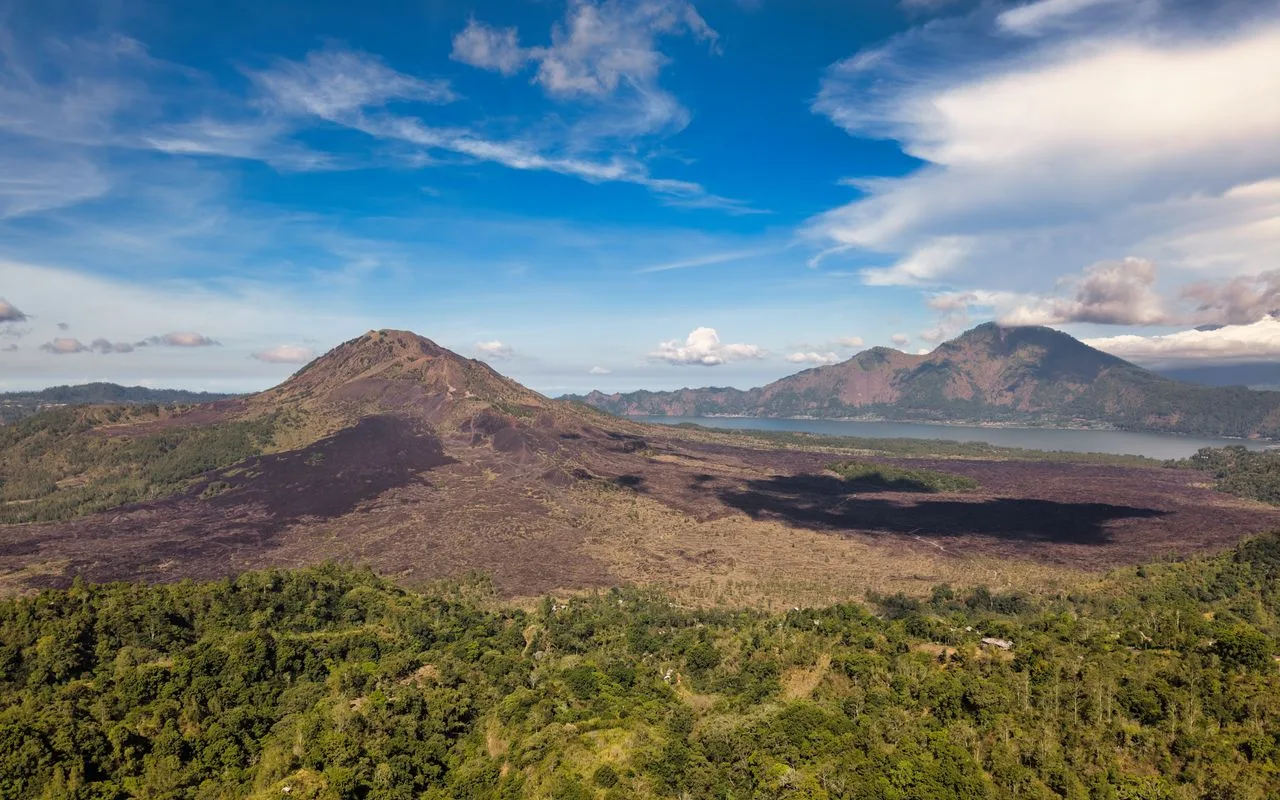
The visual reward of the day is the Batur caldera. From the rim village of Penelokan (the name literally means “place to look”), the land falls away into one of the largest calderas in the world: the black scar of Batur’s old lava flows, the still crescent of Lake Batur, and the cone of the volcano itself rising from the floor. A row of restaurants along the rim serves buffet lunch with floor-to-ceiling windows facing the view, which is exactly the kind of unhurried highland lunch this trip is built around.
Because this is a daytime trip, you arrive when the caldera is bathed in light rather than the cold dark of the sunrise hike. The trade-off is cloud: the volcano often disappears into mist by early afternoon, which is the best argument for an early start. There is a modest area conservation fee charged per person at the Kintamani entrance; carry small cash in rupiah, as we always recommend in our notes on money and ATMs in Bali.
Combining with Tegallalang, Tirta Empul & Ubud
Because the road to Kintamani runs straight through the heart of Bali, the coffee trail pairs naturally with several of the island’s headline sights. The classic combination is to come down via the Tampaksiring area and the famous emerald terraces, then drift through Ubud on the way home. Below is how the pieces fit together and roughly how long each deserves.
| Stop | What it is | Time to spend | Good to combine? |
|---|---|---|---|
| Kintamani coffee plantation | Garden walk & tasting flight | 45 min | Core stop |
| Batur caldera (Penelokan) | Rim viewpoint & buffet lunch | 60–90 min | Core stop |
| Tirta Empul | Holy spring water temple | 60–75 min | Excellent, en route |
| Tegallalang rice terrace | Sculpted valley of terraces | 45–60 min | Excellent, en route |
| Central Ubud | Market, palace, cafes | 1–2 hrs | Optional add-on |
Tirta Empul is one of Bali’s most important water temples, where Balinese Hindus perform melukat purification rituals under a row of spouts; bring a sarong and a respectful attitude. The terraces are the iconic, postcard-perfect Tegallalang rice terrace, best photographed in morning light. Trying to do all five in one day is possible but rushed, so most of our guests pick three. If you would rather make Ubud the main event with coffee as a side stop, our Ubud day trip guide sequences it the other way around.
What to buy & how to bring it home
The coffee trail is a genuinely good place to shop, as long as you buy with a little knowledge. Here is what is worth your suitcase space:
- Single-origin Kintamani arabica — the headline buy. A 200–250g bag typically runs IDR 80,000–150,000 at a plantation shop. Buy whole bean if you grind at home; it keeps fresher.
- Bali cacao & chocolate — the island has a growing bean-to-bar scene; look for craft bars rather than generic blocks.
- Vanilla pods & whole spices — lightweight, aromatic, and excellent value compared with home prices.
- Herbal teas — lemongrass, ginger, butterfly-pea and hibiscus blends pack flat and make easy gifts.
A few practical notes. Plantation prices are convenience prices — you are paying for the experience and the location, so do not expect supermarket rates. If you want volume at the best price, our guide to Bali shopping & souvenirs covers where else to stock up. For customs, sealed roasted coffee and packaged spices travel without issue to most countries; fresh fruit and unprocessed plant material generally do not, so leave the fresh produce behind.
What we arrange at Villa Soleil
A Kintamani coffee day is one of those trips that is wonderful with the right driver and frustrating with the wrong itinerary, so this is exactly where our hands-on approach earns its keep. When you stay with us, the Villa Soleil team can set up the whole day from your suite: a private car and an English-speaking driver who knows the genuinely good plantations — and quietly avoids the caged-civet operations — a sensible early departure to beat the cloud and the traffic, and a route that pairs the caldera with whichever combination of Tegallalang, Tirta Empul or Ubud suits your pace.
We will send you off with chilled water and a recommendation for the best rim restaurant for lunch, make sure you have small rupiah cash for the conservation fee, and remind the driver to build in a photo stop or two on the way down. If you fall in love with a particular Kintamani roast, our concierge can even help you find more of it before you fly home. Tell us how you like your coffee — strong, slow, or somewhere with a view — and we will shape the day around it. Message the Villa Soleil team any time on WhatsApp and we will have it arranged before you have finished your morning cup on the terrace.
Related reading
Written by the team at Villa Soleil. Message us to plan your stay in Nusa Dua.