Babi Guling in Bali: What It Is, Where to Eat It & How to Order
By Villa Soleil · Published November 2026 · 8 min read
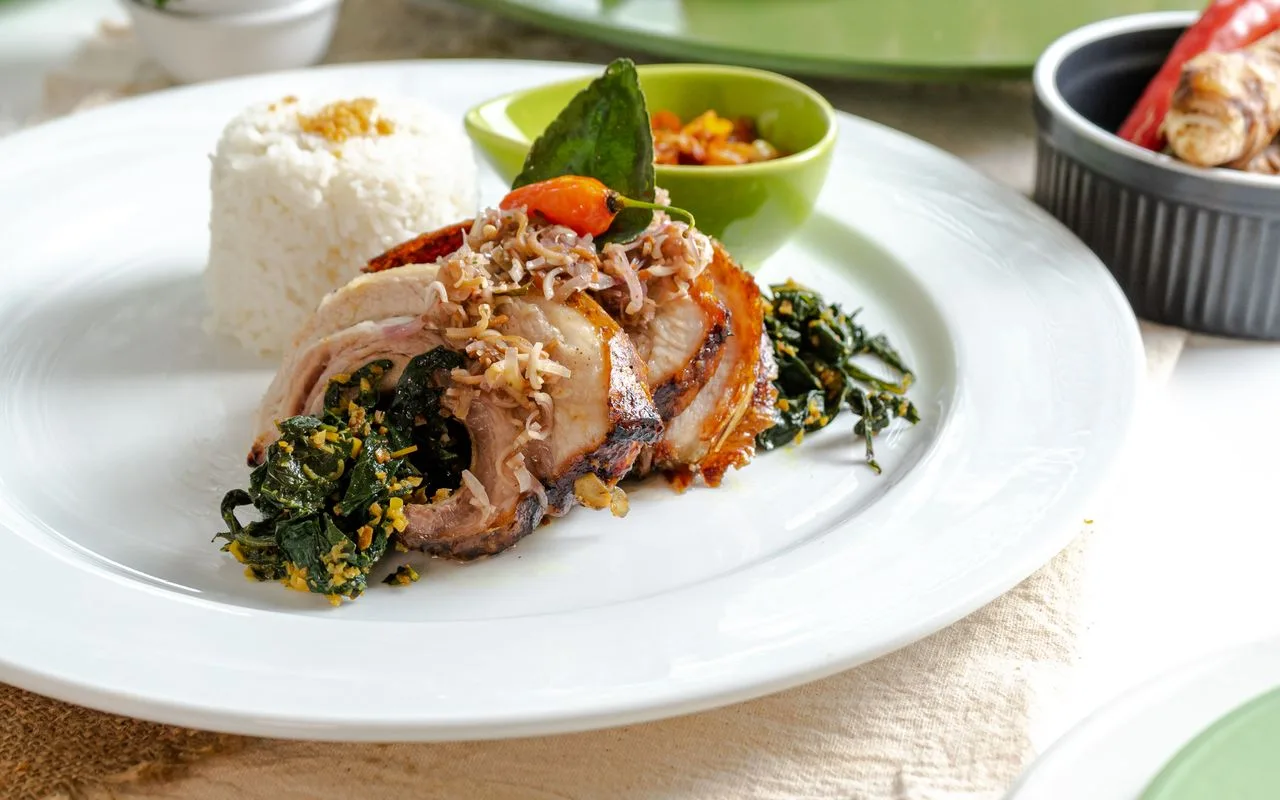
Quick answer: Babi guling is Bali’s spit-roasted young pig, seasoned with the island’s basa genep spice paste and rooted in Hindu ceremony. From Villa Soleil the closest classic is Warung Babi Guling Pak Dobiel on Jl. Srikandi in Nusa Dua, about 10 minutes away, roughly 09:00–16:00 or until sold out, at IDR 45,000–65,000 a plate; Ibu Oka in Ubud is 1.5–2 hours north at IDR 65,000–75,000. Go between 11:00 and 13:00, bring cash, and note that it is pork and not halal. A whole small pig delivered to the villa runs around IDR 1,300,000–1,500,000; a catered feast with sides roughly IDR 3,500,000–5,000,000 for 10–30 guests, with 3–7 days’ notice.
Ask a Balinese friend what to eat first and the answer is rarely a sunset-bar cocktail. It is babi guling: a whole young pig rubbed inside and out with a yellow spice paste, stuffed with cassava leaves, and turned over a coconut-husk fire until the skin blisters into glass. Guests at Villa Soleil in Benoa are unusually well placed for it. One of south Bali’s most respected warungs is about 10 minutes away by car, the Ubud and Gianyar legends make a natural lunch stop on a day trip north, and if you would rather not queue at all, our host can arrange a roasted pig or a catered Balinese feast by the pool.
What babi guling is, and why it matters in Bali
In Balinese the dish is be guling or guling celeng; guling simply means to roll or turn, which describes the hours of slow rotation over the fire. The seasoning is the island’s base paste, basa genep (often spelled bumbu genep), a pounded mix of turmeric, galangal, ginger, shallot, garlic, chilli, coriander seed, candlenut and shrimp paste. That is what stains the meat yellow and perfumes the cassava-leaf stuffing.
The ceremonial roots are real, not marketing. In Balinese Hinduism a roasted pig is a standard element of larger offerings at temple ceremonies, weddings, house blessings and village rites, and a meal shared after the offering is understood as a blessing rather than leftovers. The warung version is a twentieth-century development: families who roasted pigs for ceremonies began selling plates on ordinary days, and the best-known names today are still family operations that roast the same way. That lineage explains two things you will notice: every part of the animal is used, and the day’s pig is finite.
The classic plate
A standard nasi babi guling is a mound of white rice with a small portion of each component arranged around it. Expect most of the following, with variations by warung:
- Sliced roast pork from the shoulder or belly, yellow from the spice paste.
- A shard of crackling, which should shatter rather than bend.
- Lawar: a chopped salad of young jackfruit or long beans with coconut, spices and, traditionally, a little pig’s blood.
- A skewer of sate lilit (minced pork on lemongrass) or plain pork satay.
- Crisp fried intestine or urutan, a Balinese pork sausage.
- A ladle of clear bone broth, often served in a separate bowl.
- Fresh sambal matah (raw shallot, lemongrass, chilli and lime) or a cooked chilli sambal.
Eat it with a spoon in the right hand and a fork in the left, taking a bit of everything in each mouthful so the fat, acid and heat balance. Do not skip the broth.
Where to eat it from Nusa Dua and Benoa
Every name below is a long-running, locally busy warung rather than a tourist reproduction, and every one of them can sell out. Prices are recent listed or reported rates per plate; confirm current rates on arrival.
| Warung | Where | Drive from Villa Soleil | Hours (or until sold out) | Plate price |
|---|---|---|---|---|
| Warung Babi Guling Pak Dobiel (signed Sari Dewi) | Jl. Srikandi No. 9, Nusa Dua | About 10 min | Roughly 09:00–16:00 | IDR 45,000–65,000 |
| Babi Guling Candra | Jl. Teuku Umar No. 140, Denpasar | 35–50 min | Opens early morning | From about IDR 35,000 |
| Warung Babi Guling Pak Malen | Sunset Road No. 554, Seminyak | 45–60 min | Roughly 08:30–18:30 | Around IDR 45,000 |
| Babi Guling Ibu Oka 1 | Jl. Suweta No. 1, Ubud | 1.5–2 h | 11:00–18:00 | IDR 65,000 (Special), IDR 75,000 (Separated Special) |
| Babi Guling Pande Egi | Banjar Pande, Beng, Gianyar | 1.5–2 h | 08:00–21:00 | From about IDR 30,000 |
Pak Dobiel is the local answer and the one we send guests to first. The sign reads Sari Dewi but nobody calls it that. The room is small, the portions are modest, the bone soup has a following of its own, and a queue of office workers forms before noon. Go at 11:00 and you will eat within minutes; go at 14:00 and you may find the crackling gone.
Babi Guling Candra on Jalan Teuku Umar is Denpasar’s big-city standard-bearer: quick, popular with local families, and a sensible stop if you are already in the capital. Pak Malen on Sunset Road is the Seminyak-side favourite and the most convenient if you are heading to the beach clubs anyway; it opens early and sells out early.
North of the villa, Ibu Oka opposite Ubud Palace is the name everyone knows, with three branches in and around Ubud. It is busier and pricier than the village warungs, but the roast itself is still done properly and the Special plate is a fair introduction. Gianyar town, about 20 minutes east of Ubud, is the regency Balinese people themselves associate with babi guling. Pande Egi in Beng, with its rice-field terrace and long hours, is a strong current example, and the Gianyar night market on the main street is the place to try a plate after dark if your driver is willing.
Prices and how to order
Across the island a plate runs from roughly IDR 30,000 at a village warung to IDR 75,000 at the best-known Ubud address, so this is one of the cheapest genuinely great meals on Bali. A few phrases and habits help:
- Nasi campur babi guling, satu means one mixed plate; dua is two.
- Tambah kulit, or simply pointing to the crackling, gets you extra skin, usually for a small surcharge.
- Tidak pedas means not spicy; pedas sedikit is a little spicy. The sambal is often served on the side anyway.
- Ask for sup if the broth does not come automatically; at some warungs it is a separate item of around IDR 15,000.
- Pay at the counter, in cash. Most warungs are cash-only or accept QRIS QR-code payments from a local banking or e-wallet app; cards are rare.
Two plates and a soup between two people plus iced tea rarely exceeds IDR 150,000 in total, and a driver waiting outside will be happy to be treated to a plate as well. See our warung guide for the broader etiquette of eating in local places.
A note for Muslim guests
Babi guling is pork and is not halal, and nothing in a dedicated babi guling warung is prepared separately, including the rice and vegetables. If part of your group avoids pork, the simplest plan is to split for lunch rather than to ask a warung to adapt. Our halal food guide lists nearby options, and the Balinese answer for non-pork eaters at ceremonies is ayam betutu, a whole chicken rubbed with the same basa genep and slow-cooked in banana leaf; it delivers much of the same flavour, and several halal-certified betutu restaurants exist. Balinese hosts are entirely used to this distinction and will not be offended.
Hygiene, timing and who should skip it
The best babi guling is served the day it is roasted, which is why timing matters twice over. First, the day’s pig is roasted in the early hours and set out as soon as the warung opens, so the earlier you arrive, ideally between 11:00 and 13:00, the better your odds of warm meat and intact crackling. Second, the classic warungs do not reheat: when the day’s pig is finished they close, sometimes by early afternoon. Turning up at 15:00 in Ubud to a sold-out sign is a common disappointment.
On food safety, the roast pork itself is cooked for hours at high heat and is low risk. The elements to weigh are the components that are not cooked: lawar made with raw blood, the raw sambal matah, and anything that has been sitting in a glass cabinet since morning. A busy warung with high turnover is far safer than a quiet one with a display case, which is a good reason to prefer the famous, crowded names. Pregnant guests, small children and anyone with a sensitive stomach can simply ask for lawar putih (white lawar, made without blood) or skip the lawar altogether, and choose the cooked sambal.
Babi guling at the villa
For a group of six or eight, a whole small pig delivered to the villa is a memorable centrepiece for a birthday, a last-night dinner or a family celebration, and it is the way most Balinese eat it. There are two routes. The simplest is to order a whole roasted pig from a local roaster; a small pig collected or delivered typically costs around IDR 1,300,000–1,500,000, and arrives hot, whole and ready to carve, with sides sold separately. The more polished option is a catered Balinese feast, where a cook team delivers the pig with lawar, sate lilit, sambals, rice and krupuk, sets up, serves and clears up; expect roughly IDR 3,500,000–5,000,000 for 10–30 guests depending on the size of the pig. Most roasters ask for 3–7 days’ notice, and the pig is roasted at the supplier’s own pit rather than at the villa, so it arrives finished.
Our host can arrange either through a trusted local supplier, coordinate carving and table service at the villa, and combine it with a private chef evening so that non-pork eaters have their own betutu or grilled fish. Message WhatsApp +62 813 090 112 with your date and group size and you will usually have a quote within the hour. Our guide to Balinese dishes covers what else lands on a Balinese table.
Practical tips before you go
- Bring cash in small notes; a plate is small change and warungs rarely have change for IDR 100,000 notes early in the day.
- Dress casually but modestly; these are family rooms, not beach bars, and covered shoulders and knees are a courteous default.
- Photograph the plate, not the kitchen or the staff, unless you ask first.
- Book a driver for the Ubud and Gianyar warungs rather than ride-hailing, so you have a lift back after lunch.
Babi guling tells you something true about Bali in a single plate: the spice paste that underpins every kitchen, the ceremony that shaped it, and the practicality of a family selling until the pig runs out. Eat it early, eat everything on the plate, and if the queue at Pak Dobiel looks long, remember that it moves quickly.
Related reading
- Balinese Dishes You Should Try
- How to Eat at a Bali Warung
- Halal Food in Bali
- Private Chef at Villa Soleil
Written by the team at Villa Soleil. Message us to plan your stay in Nusa Dua.