Bali’s Art Villages: Celuk, Mas, Batuan & Sukawati
By Villa Soleil · Published July 2026 · 7 min read
- Where the art villages are, and how far from Nusa Dua
- Celuk: the silver and gold village
- Mas: the woodcarving village
- Batuan and Ubud: the painting villages
- Sukawati Art Market: the bargaining ground
- A fair-price guide and a suggested route
- Buying smart: quality, fair prices and shipping
- What we arrange at Villa Soleil
The silver pendant on a Seminyak shop shelf and the carved Buddha in a Sanur boutique were almost certainly made here—in a handful of specialist villages strung along a single road north of Denpasar, each one quietly perfecting a single craft for generations: silver in Celuk, woodcarving in Mas, painting in Batuan and Ubud, stone carving in Batubulan. For our guests at Villa Soleil, these villages make a rewarding cultural morning, and they line up neatly on the drive up to Ubud. You can watch a silversmith solder a clasp, a carver coax a face out of a block of crocodile wood, and a painter layer a Batuan-style scene—then buy the piece directly from the person who made it, usually for a good deal less than the same object costs by the beach.
This guide is the deeper companion to our Bali shopping & souvenirs article. Where that one covers markets and general gift-buying, this one is about the craft villages themselves—what each makes, what to look for so you buy quality, what a fair price feels like, and how to fold the whole route into one easy day out from Nusa Dua.
Where the art villages are, and how far from Nusa Dua
The villages sit in the Gianyar regency, between Denpasar and Ubud, along what locals simply call the road to Ubud. From Villa Soleil in Nusa Dua (Benoa), it is roughly 75–90 minutes by car to Celuk and around 90–100 minutes to Mas and Ubud, depending on traffic through Sanur and Batubulan. Because they fall on the way, the smart move is to treat them as stops on a single northbound journey: leave the villa after breakfast, work your way up village by village, and arrive in Ubud for lunch.
The order from south to north is Batubulan (stone carving), then Celuk (silver and gold), Sukawati (the art market), Batuan (classical painting), and finally Mas (woodcarving) just before you reach central Ubud. A private driver for the day lets you hop out wherever something catches your eye and keep the car waiting—far less stressful than parking and re-hailing transport at each village.
Celuk: the silver and gold village
Celuk is Bali’s jewellery heart. For decades, families here have specialised in silver and gold filigree—the delicate granulation and twisted-wire work you see in earrings, pendants, rings and the elaborate ceremonial pieces worn at temple. The main road is lined with large showrooms, but the more interesting experience is to ask a workshop if you can watch the artisans at the bench. Many welcome it; you’ll see tiny grains of silver soldered into patterns under a torch, a process that takes patience and a very steady hand.
When buying silver, look for the “925” stamp, which means sterling silver (92.5% pure). Genuine handmade filigree has slight, charming irregularities; perfectly identical machine pieces are usually imported and not what you came for. Prices vary enormously by weight and workmanship, but as a rough guide a simple sterling pendant might start around IDR 150,000–350,000, while detailed filigree earrings run IDR 400,000–1,200,000 and up.
Mas: the woodcarving village
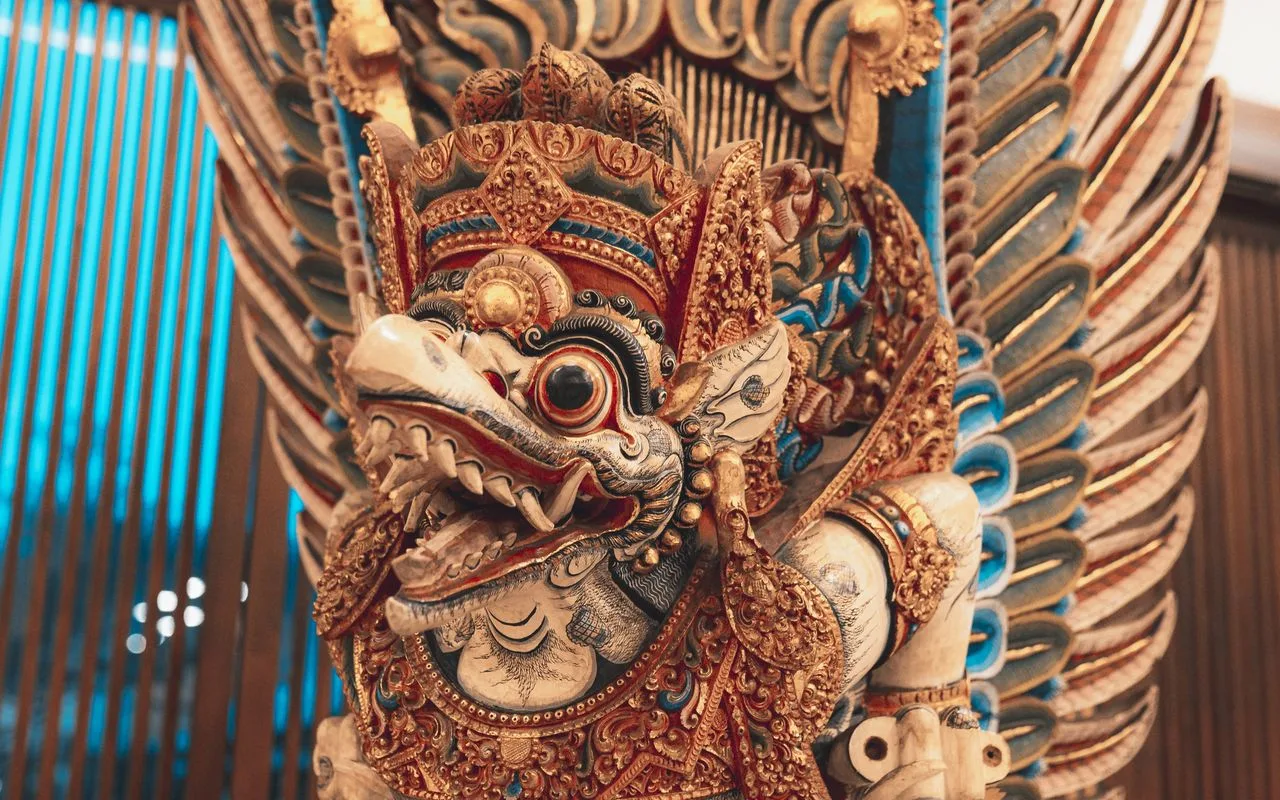
Continue north and you reach Mas, the village of master woodcarvers. This is where Bali’s figurative carving comes from—serene Buddha and deity figures, dancers caught mid-movement, abstract flowing forms, and the smooth, polished masks used in dance. The leading ateliers in Mas are effectively galleries; some are run by families whose names are known across the island, and a few welcome visitors to see apprentices learning the craft.
Quality woodcarving rewards a close look. Run your hand over the surface—fine work is smooth and even, with crisp detail in the eyes, fingers and folds of cloth. Ask what wood it is: hibiscus, jackfruit, crocodile wood (a fragrant dark wood) and ebony are common, and the timber affects both price and weight. A small, well-made carving might be IDR 250,000–600,000; a substantial signed piece by a known carver can run into the millions. If you fall for something large, our team can help arrange shipping—more on that below.
Batuan and Ubud: the painting villages
Batuan, just south of Ubud, gave its name to a distinctive painting style—dense, dark, intricate scenes of Balinese life and mythology, traditionally in ink and muted earth tones, packed corner to corner with detail. Ubud itself nurtured the modern Balinese painting movement in the 1930s, and its galleries and the Puri Lukisan and Neka art museums are worth an hour if you love painting. Between them, this is the place to buy art for the wall back home.
When buying a painting, ask whether it is original or a reproduction—both are sold, and there is nothing wrong with a well-made copy if the price reflects it. Original works are signed and usually come with the artist’s story. Look at the back, check the canvas and framing, and for anything valuable, get a simple receipt. Many guests pair a painting village stop with our Ubud day trip so they can browse the town’s galleries the same afternoon.
Sukawati Art Market: the bargaining ground
Pasar Seni Sukawati is a two-floor art market selling sarongs, woven bags, paintings, carvings, beads, kites and souvenirs of every kind. It is busiest and freshest in the morning, and it is firmly a bargaining market. Vendors open high; a relaxed, friendly counter-offer of roughly 40–50% of the asking price is a normal starting point, and you usually settle somewhere in the middle. Walk away politely if the number isn’t right—it often follows you.
Sukawati is best for volume gifts and fabrics rather than fine art; for serious silver, carving or painting, the dedicated villages give you better quality and provenance. Bring cash in small notes, keep valuables close in the crowd, and don’t feel pressured—the same goods appear at many stalls.
A fair-price guide and a suggested route
The table below gives realistic ranges and the order we suggest driving the villages from Nusa Dua. Treat prices as starting guidance—weight, materials and workmanship move them a long way.
| Village | Craft | Drive from Villa Soleil | Typical fair price (IDR) |
|---|---|---|---|
| Batubulan | Stone & statuary | ~70 min | 200,000–2,000,000+ |
| Celuk | Silver & gold | ~75–85 min | 150,000–1,200,000+ |
| Sukawati | Art market (mixed) | ~85 min | 50,000–500,000 |
| Batuan | Classical painting | ~90 min | 500,000–5,000,000+ |
| Mas | Woodcarving | ~90–100 min | 250,000–millions |
A comfortable rhythm is to leave Villa Soleil around 8:30am, browse Celuk first while the workshops are quiet, dip into Sukawati for fabrics and small gifts, stop in Mas for one special carving, then push on to Ubud for lunch and the galleries. If you would rather keep it light, pick just two villages—Celuk and Mas pair beautifully—and spend the rest of the day in Ubud or among the Tegallalang rice terraces nearby.
Buying smart: quality, fair prices and shipping
- Buy at the source. The workshops that actually make these pieces usually price them below the beach-town boutiques reselling the same goods.
- Check the marks. “925” for sterling silver; ask about wood type and whether a painting is original.
- Bargain warmly. At Sukawati it is expected; at fixed-price galleries in Mas it usually isn’t—read the room.
- Carry cash. Many small workshops prefer it; see our money & ATM guide for withdrawal tips before you go.
- Mind the airport rules. Antique-looking carvings and certain materials can need paperwork; reputable galleries will advise and can crate and ship larger pieces home.
What we arrange at Villa Soleil
We can book a trusted private driver who knows which Celuk workshops let you watch the bench and the quietest hour to reach Sukawati, and point you to Mas galleries that handle proper crating and international shipping for a large carving or painting. Message the Villa Soleil team on WhatsApp and we’ll have a driver and a sensible route ready for the morning you’d like to go.
Related reading
- Bali Shopping & Souvenirs Guide
- Ubud Day Trip from Nusa Dua
- Tegallalang Rice Terrace
- Bali Cultural Etiquette
Written by the team at Villa Soleil. Message us to plan your stay in Nusa Dua.