Electricity in Bali: Plugs, Voltage, Power Banks and the Odd Outage
By Villa Soleil · Published September 2026 · 9 min read
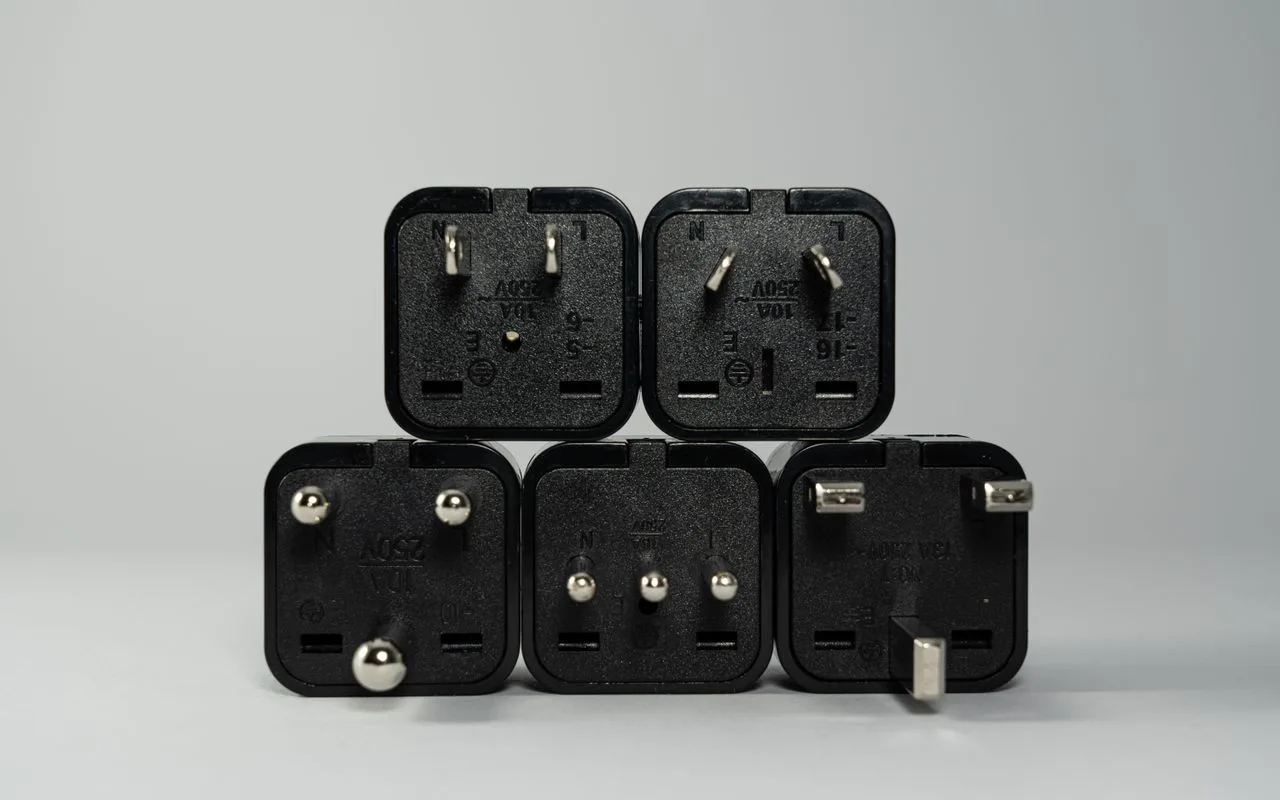
Quick answer: Bali runs on 230 V / 50 Hz with round two-pin Type C and Type F sockets, the same as Germany, France or the Netherlands. Travellers from the UK, USA, Canada, Australia, New Zealand, Japan, Singapore, Malaysia, Hong Kong and the Philippines need a plug adapter; almost no one needs a voltage converter, because phone, laptop and camera chargers are dual-voltage. Pack one adapter per two people plus a power bank under 100 Wh in your hand luggage, and expect the occasional short power cut rather than a daily problem.
- The basics: 230 V, 50 Hz, Type C and Type F
- Who needs an adapter, and who needs a converter
- What to pack, and what to buy on arrival
- Power banks and flying: the rules have tightened
- Outages: how often, how long, and what to do
- What a private villa like Villa Soleil provides
- Charging etiquette for eight people and thirty devices
- A short word on safety
Electricity is one of those holiday details nobody thinks about until the phone hits 4 percent and the charger will not fit the wall. The good news is that Bali is straightforward: one voltage, two closely related plug shapes, and a grid that works reliably most of the time. This guide covers exactly what to pack, what to skip, how to fly with power banks under the current rules, what happens when the lights do go out, and how eight people in a four-suite villa can keep everything charged without an argument over the one socket by the bed.
The basics: 230 V, 50 Hz, Type C and Type F
Indonesia, and therefore Bali, uses 230 volts at 50 hertz. Wall sockets are the round two-pin type you will recognise from continental Europe: Type C (the slim two-pin Europlug, no earth) and Type F (the recessed Schuko socket with earthing clips on the sides). A Type C plug fits a Type F socket, and in practice most sockets you meet in newer villas and hotels are Type F, with older Type C outlets in warungs, small shops and some guesthouses.
If you are arriving from Germany, France, Spain, Italy, the Netherlands, Portugal, Scandinavia, Turkey or most of Eastern Europe, your plugs simply go in. If you are coming from anywhere with flat pins, three rectangular pins or angled pins, you need an adapter. There is no need to guess at the airport; check the table below before you leave home and put the adapter in the same bag as your passport.
Who needs an adapter, and who needs a converter
These are two different things, and confusing them is the most common mistake. An adapter changes the shape of the pins so the plug fits the wall. A voltage converter changes the electricity itself, stepping 230 V down to 110 or 120 V. Almost every modern charger is dual-voltage: look at the fine print on the brick and you will see “INPUT: 100–240 V, 50/60 Hz”. Phones, tablets, laptops, cameras, e-readers, electric toothbrushes, smartwatches and most hair straighteners all fall into this group, and they only need an adapter.
The devices that genuinely need a converter are single-voltage appliances built for North American or Japanese 100–120 V power: some hairdryers, curling wands, older shavers, and small kitchen gadgets. Plugging a 120 V-only hairdryer into a Bali socket via a simple adapter will burn it out in seconds and can trip the breaker. Our honest advice is to leave those items at home. A villa hairdryer is provided in every suite, and a compact dual-voltage travel model costs less than a converter heavy enough to run a heating appliance.
| Home country | Plug type at home | Adapter needed in Bali? | Converter needed? |
|---|---|---|---|
| Germany, France, Netherlands, Spain, Italy, Scandinavia | C / E / F (Italy also L) | No; Italian three-pin Type L needs an adapter | No (230 V at home) |
| United Kingdom, Ireland, Singapore, Malaysia, Hong Kong | G | Yes | No (230–240 V at home) |
| Australia, New Zealand, China | I | Yes | No (220–240 V at home) |
| USA, Canada, Mexico | A / B | Yes | Only for single-voltage 120 V appliances |
| Japan, Taiwan | A / B | Yes | Only for single-voltage 100–120 V appliances |
| Philippines | A / B (C often fits) | Usually yes | No (220 V at home) |
| India, South Africa | D / M (C often fits) | Usually yes | No (230 V at home) |
| Switzerland | J | Type C plugs fit; three-pin J needs an adapter | No |
What to pack, and what to buy on arrival
You can travel light on this. A realistic kit for a couple sharing one suite looks like this:
- One universal adapter with two or more USB-A/USB-C ports. Buy the kind with a built-in fuse and a grounded pin option, not the lightest plastic cube on the shelf. Two per family of four is comfortable.
- A multi-port GaN charger (65 W or so) with a Type C or F plug lead. One charger can run a laptop, a phone and a watch overnight, which is worth more than three separate bricks.
- A short extension strip from home if you have a lot of gear. Villas rarely have more than two or three sockets per room, and camera batteries, drones and gimbals add up quickly.
- A power bank in the 10,000–20,000 mAh range for long day trips, boat crossings to Nusa Penida, or a sunrise hike where you will be away from a wall for twelve hours.
If you forget the adapter, do not panic. Universal travel adapters are stocked at Indomaret and Alfamart minimarkets and at the electronics kiosks inside Bali Collection, about 8 minutes from the villa; expect roughly IDR 25,000–70,000 for a basic one and IDR 100,000–250,000 for a branded multi-USB model at Ace Hardware or a phone shop. A four-outlet extension lead with Indonesian plugs runs about IDR 40,000–120,000. Prices move with the exchange rate, so confirm current rates in store. Our full Bali packing list has the rest of the checklist if you are still at the drawer-emptying stage.
Power banks and flying: the rules have tightened
Since 2025 Indonesian carriers (Garuda, Citilink, Lion Air, Batik Air, AirAsia Indonesia) and most international airlines have enforced stricter lithium battery rules, and this is where a good holiday can start with a bad morning at check-in. The essentials are consistent across airlines, though the details vary and are worth checking on your carrier’s website the week before you fly:
- Power banks must go in hand luggage only, never in checked bags.
- Up to 100 Wh (roughly 20,000 mAh at 5 V) is allowed without approval; 100–160 Wh needs airline approval in advance and is usually capped at two units; over 160 Wh is not permitted.
- Several airlines now require power banks to stay in the seat pocket or under the seat rather than the overhead locker, and prohibit using them to charge devices in flight.
- The capacity must be printed legibly on the unit. Faded or unlabelled power banks are routinely confiscated at Ngurah Rai security.
A 20,000 mAh unit is the practical ceiling for most travellers: within the limit, enough for two phones for a full day out, and small enough to sit in a daypack. Our airport guide covers the rest of the arrival process, from the e-arrival card to finding your driver.
Outages: how often, how long, and what to do
Bali draws roughly a quarter to a third of its electricity from Java through undersea cables, and a fault on that link can trip the island's own plants. Day to day, the island has occasional short cuts, most often in the wet season (roughly November to March) when lightning and heavy rain stress the network. A typical outage lasts a few minutes to an hour and affects one neighbourhood; you will hear generators start up along the road and the lights return before you have finished wondering about it. In May 2025 a transmission fault in East Java caused a rare island-wide blackout that lasted most of an afternoon and evening for many areas, with rolling cuts in the days that followed. That event made headlines precisely because nothing on that scale had happened for around twenty years.
Practical habits that make outages a non-issue:
- Charge phones and power banks overnight rather than waiting until they are low.
- Keep a small torch or your phone light handy in the bedroom; villa paths and pool edges are dark without the garden lighting.
- Download offline maps and your boarding pass before you need them. Mobile data usually keeps working through short outages because cell towers have battery backup, but not always; see our note on SIM cards and internet in Bali.
- Locals check the PLN Mobile app for scheduled maintenance notices; your host will pass on anything relevant to the Benoa area.
Air conditioning is the thing most guests miss during a cut. In the dry season a power bank-fed LED lamp and an open window turn a cut into a small adventure; in the wet season it is worth knowing which rooms catch the breeze. Our rainy season guide covers what else changes between November and March.
What a private villa like Villa Soleil provides
This is where a villa has an edge over a hotel room with two sockets behind the nightstand. At Villa Soleil, each of the four suites has Type F sockets on both sides of the bed plus at least one at the desk, and every suite has a hairdryer, so that is one heating appliance you can strike off the list. The living pavilion and dining area have additional outlets and USB charging points, and there is a multi-outlet extension strip available on request for guests travelling with camera or drone kits. Wi-Fi covers the whole property including the pool deck.
We are candid about one thing: the villa does not run a whole-house generator, and neither do most private villas in Nusa Dua. What we do have is backup lighting on the main paths and pool area, and a host who lives close by and answers WhatsApp within the hour. If a cut is announced in advance, you will know; if one happens unexpectedly, someone will check on you. For a longer working stay, our digital nomad guide discusses backup connectivity in more detail.
Charging etiquette for eight people and thirty devices
Two families, or one family of eight, arrive with phones, watches, tablets, earbuds, cameras, a laptop or two and possibly a child’s tablet with a very strong opinion about its battery level. A few house rules keep the peace:
- Agree on a charging station: one extension strip on the living-room sideboard where shared devices live, so nobody is unplugging a camera battery to top up a phone.
- Keep bedside sockets for bedside devices. Phones and watches charge overnight in the suite; cameras and drones charge at the station during the day.
- Label chargers with a strip of tape. Identical white USB-C bricks vanish at exactly the rate you would expect.
- Never charge power banks or e-bike batteries unattended on soft furnishings or in a hot car. Lithium cells and Bali afternoon heat are not a good combination.
- Unplug adapters when you head out for the day. Indonesian sockets do not always have switches, and a dangling charger by a wet pool towel is a risk that is easy to avoid.
A short word on safety
Indonesian wiring in reputable villas and hotels is fine, but the country does not enforce the same earthing standards everywhere, and cheap adapters are the weak link. Choose a fused adapter, avoid stacking adapters on adapters, and if a socket feels loose or a plug sparks, use another one and tell the host. Keep devices away from the pool edge and outdoor showers, and do not use extension leads in the rain. That is genuinely the whole list. Electricity in Bali is a packing question, not a worry, and once the adapter is in the bag you can go back to deciding between the beach and the pool.
Related reading
- Bali Packing List: What to Bring and What to Leave
- SIM Cards and Internet in Bali
- Ngurah Rai Airport Guide
- Bali in the Rainy Season
Written by the team at Villa Soleil. Message us to plan your stay in Nusa Dua.