Padang Padang Beach from Villa Soleil: Cave, Tides, Surf and When to Go
By Villa Soleil · Published November 2026 · 8 min read
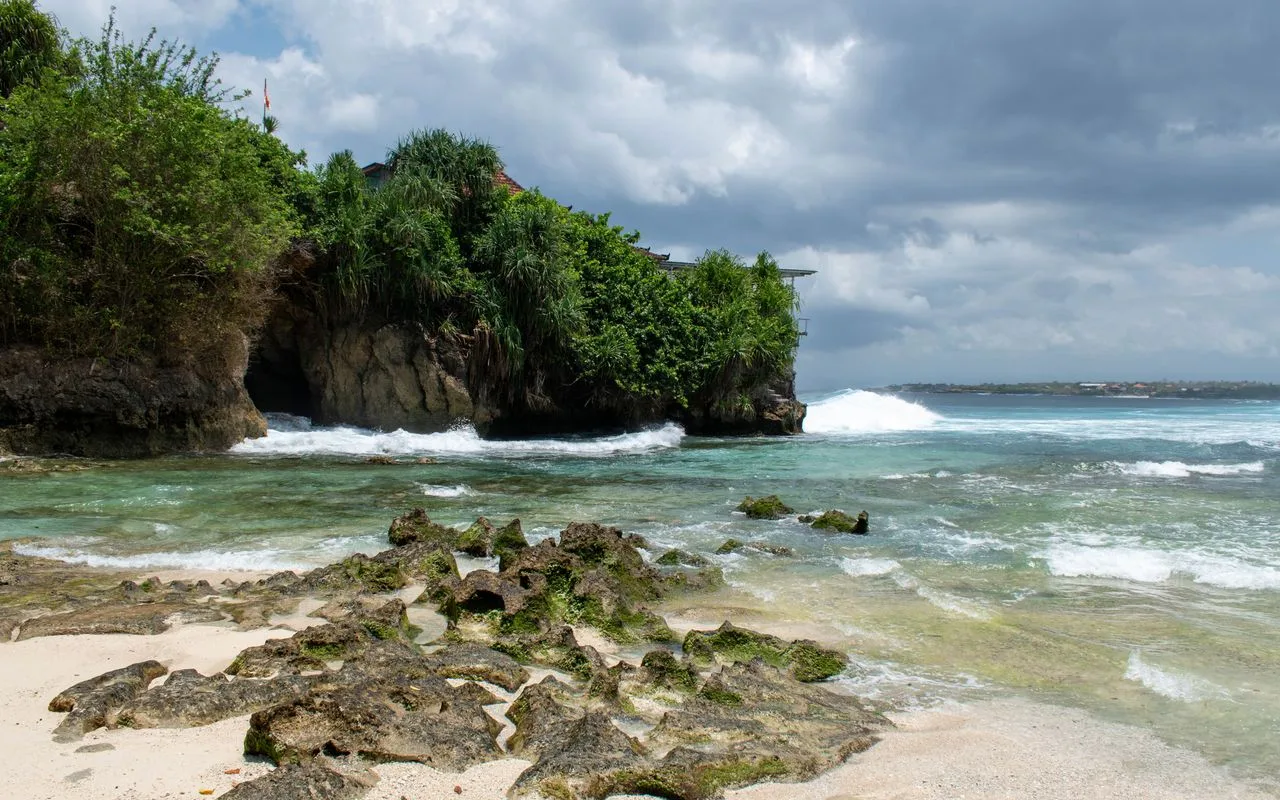
Quick answer: Padang Padang is 35-45 minutes from Villa Soleil. Entry is IDR 15,000 for international adults (IDR 10,000 for children 3-10; domestic IDR 10,000 and IDR 5,000), cash only, plus a few thousand rupiah for parking. You reach the sand through a narrow rock crevice and about 120 steps, so it is not pram-friendly. Go before 9 am on a falling tide for calm lagoon swimming; 3 pm to sunset is the busiest window. Watch the monkeys near the ticket booth, then finish the day with the 6 pm Kecak at Uluwatu Temple, 15 minutes south.
Padang Padang is the beach most people picture when they think of Uluwatu: a pocket of pale sand wedged beneath limestone cliffs, reached by squeezing through a crack in the rock and down about 120 steps. It sits 35-45 minutes by car from Villa Soleil, an easy half-day from Benoa, and it pairs naturally with an evening at Uluwatu Temple. It is also small, famous and frequently packed, so timing matters. This guide covers the cave entrance, tides and swimming, the two celebrated surf breaks, the fee, the monkeys, and when to swap it for Bingin or Suluban instead.
Getting there from Villa Soleil
From Benoa and Nusa Dua the drive runs west across the Bukit Peninsula along Jalan Uluwatu, past Jimbaran and the GWK turn-off, then down through Pecatu to Labuan Sait. Allow 35-45 minutes without traffic and closer to an hour on a late-afternoon weekend, when the whole peninsula heads the same way for sunset. There is no road to the sand: you park on the clifftop beside the Labuan Sait bridge and the beach is directly below. Parking is a few thousand rupiah per vehicle (roughly IDR 2,000-5,000, cash), and the car area fills by late morning, so a driver who can drop you at the bridge and circle back is a genuine advantage. Our host can arrange a private driver for the day, typically IDR 600,000-900,000 for 8-10 hours including fuel; confirm the current rate when you book.
The cave entrance, the stairs and the fee
The ticket booth is at the top of the cliff. The entrance fee is IDR 15,000 for international adults and IDR 10,000 for children aged 3-10; Indonesian residents pay IDR 10,000 and IDR 5,000. It is cash only, so carry small notes, and fees can nudge upward around holidays, so treat these as current but changeable. Beyond the booth, the path drops through a narrow crevice between a fallen boulder and the cliff face, tight enough in places that you turn sideways. The roughly 120 steps are uneven and often damp, with no handrail on much of the route. Wear proper sandals rather than flip-flops, leave the pram and the cool box in the car, and think twice if anyone in your party struggles with stairs. The reward is a sudden opening onto a cove perhaps a hundred metres long, ringed by rock and shaded in the morning by the cliff behind it. Basic toilets and outdoor showers cost a small extra fee, and a handful of warungs on the sand sell young coconuts (IDR 20,000-30,000), cold drinks and simple plates of nasi goreng or grilled fish for IDR 40,000-80,000. If the cove looks familiar, a scene from the 2010 film Eat Pray Love was shot here, which is one reason the tour buses keep coming.
Tides, swimming and the lagoon
Padang Padang is fringed by reef, and the tide decides what kind of beach you get. At low to mid tide the inner lagoon is calm, shallow and clear, with tide pools along the rocks where children can spot small fish and crabs, and the sand stretches wide enough to spread out. At high tide, especially on a big dry-season swell, the sand shrinks to a strip and the cove feels crowded even with modest numbers on it. Check a tide table before you leave the villa and aim for a falling tide in the morning. Swimming inside the reef is generally gentle, but the famous break is only a short distance out, so stay in the lagoon, keep small children within arm’s reach and do not assume a lifeguard is watching. Reef shoes are worth packing, because the rocks near the water are sharp.
The surf: Padang Padang, Impossibles and Baby Padang
This cove is famous less for its sand than for the left-hander that breaks over the reef at its mouth. Padang Padang Lefts, sometimes called the Balinese Pipeline, is a short, hollow, barrelling wave that only comes alive on a solid swell, mostly between May and October, and it is strictly for expert surfers used to shallow reef. For everyone else it is a spectator sport, and a very good one. The Rip Curl Cup, an invitational contest with a local trials round, uses a waiting period in the dry-season swell months, and the 2026 edition ran through August; on a contest day expect the beach, the parking and the road to be at their busiest.
Just north of the cove, on the same reef platform, is Impossibles: a long, fast left with several take-off zones, named for how rarely a wave lets you make every section. The top and middle sections throw fast walls, the end opens up for turns, and the reef beneath is among the sharpest on the Bukit, so most surfers prefer mid to high tide; it suits confident intermediates and above. Inside the bay itself is Padang Padang Rights, usually called Baby Padang, a gentle wave that reforms across the reef and is one of the most popular lesson breaks in Bali because a channel carries you to the line-up without a battle through white water. Expect around IDR 100,000 for a board rental and roughly IDR 400,000 for a one-hour lesson, rates that vary by school and season. Our beginner surfing guide compares the Bukit lesson spots with the softer beach breaks around Kuta.
The monkeys
A troop of long-tailed macaques lives around the ticket booth and the upper stairs, and they have learned exactly what tourists carry. Sunglasses, hats, loosely held phones and anything in a plastic bag are the usual targets. Keep food out of sight, pocket your glasses before you start down and never feed them, however photogenic they are. If a monkey grabs something, do not chase or shout; the local staff are practised at coaxing items back. Bites are rare but not unheard of, and rabies is present in Bali, so any broken skin should be washed immediately and assessed the same day at BIMC Siloam Nusa Dua inside the ITDC enclave, the nearest full hospital to the villa.
When it is packed, and when it is not
Because the cove is so small, the difference between a serene morning and a shoulder-to-shoulder afternoon is a matter of hours. Between 7 and 9 am you may share the sand with a few surfers and a dog; by 10 or 11 the tour buses arrive; from about 3 pm until sunset the beach is at its fullest as day-trippers come for the golden light. Weekends and Indonesian public holidays add domestic visitors, and August combines peak international season with peak swell. The wet season from November to March brings smaller crowds and smaller surf, with the trade-off of afternoon storms. Our preferred rhythm is to be on the sand by 8:30, swim on the falling tide and be back up the stairs before the midday heat, or to come around 4 pm for an hour of surf-watching before driving on to the temple.
Bingin and Suluban: the alternatives
If the parking is full or the cove is heaving, two beaches within ten minutes offer a different mood.
| Beach | Entrance & parking | Access | Best for |
|---|---|---|---|
| Padang Padang | IDR 15,000 adult, IDR 10,000 child; parking about IDR 2,000-5,000 | About 120 steps through a rock crevice | Swimming in the lagoon, watching world-class surf |
| Bingin | Free entry; parking about IDR 5,000 scooter, IDR 10,000 car | About 187 steps through cliffside villas | Cliff warungs, grilled fish at sunset, a quieter sand |
| Suluban (Blue Point) | Free entry; parking about IDR 5,000 scooter, IDR 10,000 car | Stairs and a walk through sea caves at low tide | Watching the Uluwatu break, cliff bars, photography |
Bingin, a few minutes north, has no ticket booth, only a parking charge, and its 187 or so steps thread between clifftop guesthouses to a slim beach that nearly vanishes at high tide. Its charm is the row of warungs stacked up the cliff, where grilled fish at sunset is a Bukit ritual. Suluban, better known as Blue Point, sits a few minutes south beneath the Uluwatu surf bars: you descend stairs and, at low tide, pick your way through sea caves to a rocky shore that is more for watching surfers and taking photographs than for swimming. Neither is a swimming beach in the way Padang Padang is at low tide, but both escape the crowd that a film and a famous wave attract. For a beach with a road to the sand and no stairs at all, Melasti, 40-50 minutes from the villa, suits guests with limited mobility far better.
Pairing Padang Padang with the Uluwatu sunset
The classic day is a morning on the sand and an evening at Pura Luhur Uluwatu, about 15 minutes further south along the cliffs. The temple opens 7 am to 7 pm and charges IDR 60,000 for international adults and IDR 40,000 for children, with domestic visitors at IDR 40,000 and IDR 30,000; a sarong and sash are included. The Kecak fire dance in the clifftop amphitheatre runs daily at 6 pm, costs IDR 150,000 for adults and IDR 75,000 for children aged 2-9, and is bought separately; the gate opens at 4 pm and a second 7 pm show is sometimes added in peak season. Confirm prices and times when you book, as both have risen in recent years; our Uluwatu sunset guide covers seating and sarong etiquette in detail.
- 8:00 am: leave Villa Soleil after breakfast, arriving at Labuan Sait by about 8:45.
- 9:00-11:30 am: swim the lagoon on the falling tide, watch the surf, lunch at a warung.
- Midday: retreat to a cliff cafe at Bingin or Suluban, or nap back at the villa.
- 4:30 pm: enter Uluwatu Temple, walk the cliff path and claim seats in the amphitheatre.
- 6:00 pm: Kecak as the sun drops; dinner afterwards on the sand at Jimbaran Bay or with a private chef at the villa.
The drive back to Benoa from the temple takes 45-60 minutes in the evening. Message Villa Soleil on WhatsApp and the team will set up a driver for the whole day before you arrive.
Related reading
- Uluwatu Temple at sunset: Kecak, fees and timing
- Uluwatu area guide: beaches, cliffs and cafes
- Melasti Beach: the drive-down alternative on the Bukit
- Learning to surf in Bali: where beginners should start
- Uluwatu Weather and Surf: Season, Swell and Tide Explained — Uluwatu works on a southeast wind through the dry season
- Uluwatu Beaches Sorted by Effort: Steps, Fees, Drive Times — Seven Uluwatu beaches sorted by effort from Nusa Dua: steps, cash fees
Written by the team at Villa Soleil. Message us to plan your stay in Nusa Dua.