Diamond Beach & Atuh Beach: The East Nusa Penida Day Trip, Honestly
By Villa Soleil · Published October 2026 · 8 min read
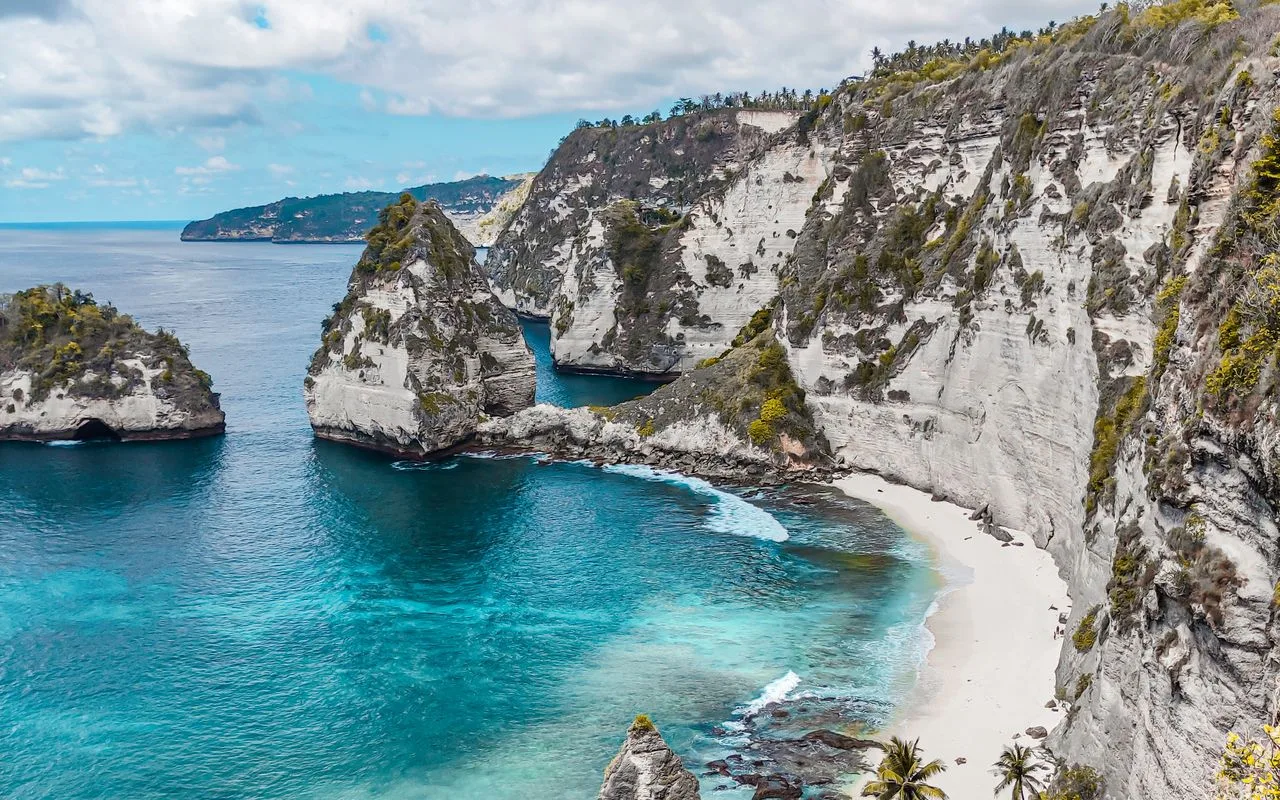
Quick answer: Diamond Beach and Atuh Beach are on the far east coast of Nusa Penida, 60–90 minutes of rough road from the fast-boat harbours. The carved cliff stairs are steep and unshaded, Diamond Beach is not safe for swimming (Atuh is, at low tide only), and the day from Nusa Dua runs 12–13 hours door to door. Choose east or west Penida, never both in one day, and take the earliest boat from Sanur.
Diamond Beach is the photograph that sells Nusa Penida: a wedge of white sand pinned between limestone cliffs, a cluster of rock spires standing in turquoise water, and a staircase cut straight into the cliff face. Atuh Beach, one headland to the south, is quieter, longer and slightly more forgiving. Both sit on the far east coast of the island, which is precisely the problem. Getting there from Villa Soleil means an early alarm, a fast boat from Sanur and a long, rough drive across Penida before you have seen a single spire. This guide is about whether that trade is worth it for your group, and how to do it without regretting the choice by mid-afternoon.
Where Diamond and Atuh actually are
Nusa Penida is a big, dry, hilly island roughly 200 square kilometres in size, and its roads are still a mix of decent asphalt and lurching, potholed stretches. The harbours where fast boats land (Banjar Nyuh, Toya Pakeh, Sampalan and Buyuk) are all on the north coast. Diamond Beach and Atuh Beach are in the south-east corner, near Pejukutan village, as far from the boats as the island allows. Expect 60–90 minutes of driving each way from the harbour, longer if the road crews are working or your driver stops at Teletubbies Hills on the way.
The two beaches share the same cliff-top car park area. From the ticket hut you walk a few minutes along the headland: one path drops to Diamond Beach, another to Atuh. A short drive further along the same coast is the Thousand Islands viewpoint (Bukit Molenteng) with the much-photographed treehouse cabins. Most drivers bundle these together as the "east tour"; Banah Cliff, on the south coast, belongs to a separate southern loop.
The Diamond Beach stairs, honestly described
The staircase is the reason Diamond Beach became famous and also the reason to think twice. It was hand-cut into the limestone in 2018 and follows the natural contours of the cliff, so the steps are uneven in height, some are little more than notches, and the only handrail is a rope threaded through metal stakes. Parts of the route are narrow enough that people going up and down have to wait for each other.
Going down takes 10–20 minutes at a careful pace. Coming up is the workout: several hundred steps in full sun with no shade until you reach the top. Wet rock after rain is genuinely slippery, and in the wet season (roughly November to March) the lower steps can be soaked by spray. We would not suggest it for anyone unsteady on their feet, for toddlers who need carrying, or for guests with knee or heart issues. Older children who hike comfortably are usually fine with an adult behind them.
- Wear shoes with grip, not flip-flops; carry sandals for the sand if you like.
- Bring a small bag with water, a hat and reef-safe sunscreen. There is no shop at the bottom.
- Keep both hands free on the descent. Phones and cameras go in a zipped pocket or bag.
- Go early. By 10:00 the stairs turn into a slow, hot queue of photographers.
- If the sea is visibly heavy at the top, enjoy the viewpoint and skip the descent.
Swimming: why the water here is not the point
This is the part visitors most often get wrong. Diamond Beach faces the open sea at the southern mouth of the Lombok Strait, and Indian Ocean swell rolls straight onto it. There is a heavy shore break, the sand drops away steeply, and rip currents pull along the rock spires. There are no lifeguards. People have been swept out here, some knocked over by a single wave while standing at the water’s edge, and rescues are slow because the only way up is the staircase. There is an official no-swim, no-paddle rule: treat Diamond Beach as a place to photograph from well back from the waterline, not a swimming beach.
Atuh Beach is a better bet if you want to get wet. At low tide a rock shelf and reef fringe calm the inner lagoon and you can wade and float in waist-deep water. At high tide or in a big swell the same beach becomes rough, so ask your driver about the tide before you commit to the stairs. Even here, keep children within arm’s reach and stay away from the northern rocks where the current runs. If serious snorkelling is what you are after, the reefs on the west side around Crystal Bay and Manta Point are the better use of a boat day; plan that as a separate west-coast day.
East Penida versus west Penida: pick one
The single most useful piece of advice we can give: do not try to do both coasts in one day from Nusa Dua. Drivers will offer it. On paper it works. In practice you spend six hours in a car, see each stop for twenty minutes and come home wrecked. Choose a side.
| Factor | East tour (Diamond, Atuh, Thousand Islands) | West tour (Kelingking, Broken Beach, Angel’s Billabong, Crystal Bay) |
|---|---|---|
| Drive time from harbour | 60–90 min each way | 45–75 min each way |
| Crowd level | Busy at Diamond, calmer at Atuh | Very busy, especially Kelingking |
| Physical effort | Steep stairs at both beaches | Kelingking descent is harder and longer; viewpoints are easy |
| Swimming | Atuh at low tide only | Crystal Bay is the reliable swim stop |
| Best for | Photographers, fewer stops, a slower pace | First-timers wanting the famous shot |
| Hours door to door | 12–13 | 11–12 |
If this is your first visit and you have a single day, the west coast delivers the iconic Kelingking view and a proper swim; our Kelingking Beach guide covers that descent. Choose east if you have already seen the west, if you are a photographer who prefers fewer people, or if you simply like the look of Diamond Beach more than the T-Rex. In our experience the east coast makes the better second visit.
Fast boats from Sanur: the logistics
From Villa Soleil the departure point is Sanur harbour, a 30–45 minute drive north in early traffic. The modern harbour has a proper terminal, a ticket check and a queue system, so it is far more civilised than the beach-launch days, but boarding still involves walking a jetty and stepping onto a moving boat. The crossing takes roughly 30–45 minutes depending on the boat and the sea; the Badung Strait can be lively in the dry-season trade winds, so motion-sickness tablets are a sensible precaution.
Operators run several morning departures, with the first boats typically leaving between about 07:00 and 08:30 and the last returns in the mid to late afternoon. For an east-coast day you want the earliest crossing you can manage, which means leaving the villa around 06:00. Fares for foreign visitors generally sit somewhere in the region of IDR 150,000–350,000 per person each way depending on the operator, class and whether a harbour transfer is included; confirm current rates when you book, and expect the IDR 25,000 per-person Nusa Penida retribution (bought online in advance since early 2026) and small harbour fees on top. Our host can book the boat and a Penida driver together so you are met at the pier rather than negotiating in the sun. For a broader picture of the port town, see the Sanur day trip guide.
A realistic timeline and budget
Here is how the day usually runs for a group of four to eight leaving from Benoa. Times are indicative; the boat and the roads decide the rest.
- 05:45–06:00: leave the villa with a packed breakfast; our team can arrange this the night before.
- 06:45–07:15: check in at Sanur harbour; boats often board 20–30 minutes before departure.
- 08:00–08:45: land on Penida, meet your driver, head east.
- 09:30–12:30: Diamond Beach stairs and viewpoint, then Atuh Beach, then Thousand Islands viewpoint.
- 12:30–13:30: lunch at a cliff-top warung or a simple restaurant on the way back.
- 14:30–15:30: return to the harbour with a margin for road delays.
- 16:00–17:00: fast boat back to Sanur.
- 17:30–18:30: home to the villa and straight into the pool.
Budget per person for the day, on top of the boat: a private car and driver on Penida usually costs IDR 600,000–900,000 for the vehicle for the day, beach entrance and parking fees are modest but charged per site (tens of thousands of rupiah each; confirm on the day), and a warung lunch runs IDR 40,000–90,000. Scooters are cheap to hire on the island but the east roads are exactly where inexperienced riders come to grief; we do not recommend them for this route. More on hiring a car for the mainland leg is in our private driver guide.
The fatigue note nobody puts in the brochure
An east Penida day from Nusa Dua is twelve to thirteen hours door to door, with two boat crossings, three hours of jolting roads and two steep staircases in tropical heat. That is not a criticism; it is the honest shape of the day. Guests who enjoy it most are the ones who plan around it: nothing booked the evening before, nothing booked the morning after, and a slow pool day or a spa visit to follow. If someone in your party is over seventy, pregnant, or travelling with a child under five, an easier version exists: skip the stairs entirely and enjoy the viewpoints, or swap Penida for a gentler boat day such as Nusa Lembongan, which has calmer roads and beaches you can actually swim from.
What makes it work from a private villa is the recovery. Coming back to Villa Soleil means your own pool at dusk, a private chef who has dinner ready when the car pulls in, and no lobby to cross in sandy shoes. Message our host on WhatsApp with your dates and the number in your group and we will map the boat, the driver and the meals around the tides, with better rates when you book direct.
Related reading
- Nusa Penida Day Trip from Nusa Dua
- Kelingking Beach: The West Penida Icon
- Nusa Lembongan: The Gentler Island Day
- Sanur Day Trip and Harbour Guide
Written by the team at Villa Soleil. Message us to plan your stay in Nusa Dua.